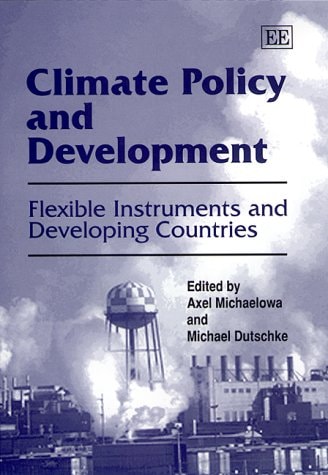
Climate Policy and Development: Flexible Instruments and Developing Countries
0
0
As an Amazon Associate and affiliate partner, Menrva Books earns from qualifying purchases. Learn more
Author Description
Product Description Industrialized countries strive to fulfil at least part of their obligation to reduce greenhouse gases by investing in projects in developing countries rather than at home. Developing countries have been rather critical of this idea. This book outlines the development of the international negotiations on the subject and analyses different design options for the Clean Development Mechanism (CDM), taking into account the interests of various groups, especially host countries. Two case studies - one on a renewable energy project in Indonesia and another on Costa Rican climate policy - show the problems that are likely to be encountered by CDM and illustrate the importance of active host country involvement. The authors discuss the problems that will be addressed by forthcoming negotiation rounds and propose practical solutions for the CDM including baseline-setting, institutional structure and credit sharing. Moreover, a long-term view on linking climate and development policy is taken to achieve an equitable allocation of emission rights. Review '... the book is technical but engaging. It has the potential to help those scholars with little background in climate change policy deal with its complex politics. It is likely to be of interest to researchers in environmental sciences and climate change, and those policymakers and practitioners responsible for studying, designing and implementing AIJ and CDM projects.' About the Author Edited by Axel Michaelowa, Department of Political Science, University of Zurich and Center for Comparative and International Studies (CIS), Switzerland and Perspectives Climate Research, Germany and Michael Dutschke, Managing Director, BioCarbon Consult, Germany
Menrva's Summary
THE THESIS
This book investigates the complex interplay between climate policy and development, focusing on the implementation of flexible instruments like the Clean Development Mechanism (CDM) in developing countries. It examines the motivations of industrialized nations seeking to meet emission reduction targets through investments abroad, and the critical stance of developing nations. The analysis delves into various design options for the CDM, prioritizing the interests of host countries, and uses case studies from Indonesia and Costa Rica to highlight potential challenges and the necessity of active host country participation. The authors propose practical solutions for future negotiation rounds concerning baseline-setting, institutional frameworks, and credit sharing, while also considering a long-term perspective on integrating climate and development policies for equitable emission rights allocation.
THE SCOPE MAP
- Analysis of international negotiations on greenhouse gas emission reduction obligations.
- Detailed examination of design options for the Clean Development Mechanism (CDM).
- Consideration of the interests of various stakeholder groups, particularly host countries.
- Case study: Renewable energy project in Indonesia.
- Case study: Costa Rican climate policy.
- Discussion of problems likely to be encountered by CDM projects.
- Importance of active host country involvement in climate policy.
- Proposed practical solutions for baseline-setting, institutional structure, and credit sharing within the CDM.
THE AUTHORITY PERSPECTIVE
The book is described as technical yet engaging, with the potential to assist scholars less familiar with climate change policy in navigating its complex politics. It is anticipated to be of interest to researchers in environmental sciences and climate change, as well as policymakers and practitioners involved in the design and implementation of AIJ and CDM projects. The review suggests the work offers valuable insights into the practical challenges and policy considerations surrounding international climate initiatives.
Page Count:
288
Publication Date:
2000-07-25
Publisher:
Edward Elgar Publishing
ISBN-10:
1840643315
ISBN-13:
9781840643312
Economics
Politics
Non-Fiction
International relations
Climate Change
Community Tags
Similar Books