Author Description
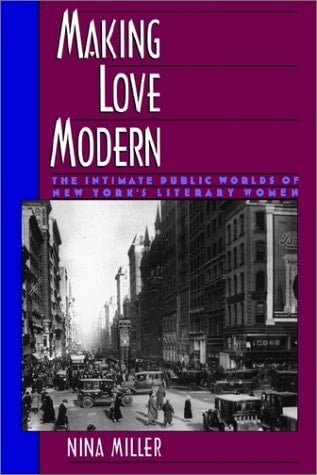
Product Description In the teens and twenties, New York was home to a rich variety of literary subcultures. Within these intermingled worlds, gender lines and other boundaries were crossed in ways hardly imaginable in previous decades. Among the bohemians of Greenwich Village, the sophisticates of the AlgonquinRound Table and the literati of the Harlem Renaissance, certain women found fresh, powerful voices through which to speak and write. Edna St. Vincent Millay and Dorothy Parker are now best remembered for their colorful lives; Genevieve Taggard, Gwendolyn Bennett and Helene Johnson are hardlyremembered at all. Yet each made a serious literary contribution to the meaning of modern femininity, relationship, and selfhood. Making Love Modern uncovers the deep historical sensitivity and interest of these women's love poetry. Placing their work in the context of subcultures nested withinnational culture, Nina Miller explores the tensions that make this literature so rewarding for contemporary readers. A poetry of intimate expression, it also functioned powerfully as public assertion. The writers themselves were high-profile embodiments of femininity, the local representatives ofNew Womanhood within their male-centered subcultural worlds. Making Love Modern captures the literary lives of these women as well as the complex subcultures they inhabited---Harlem, the Village, and glamorous Midtown. In the end, the book is a much a study of modernist New York as of women's lovepoetry during modernism. From Library Journal In this feminist study, Miller explores the lives and love poetry of modernist women writers in the literary subcultures of New York in the late 1910s and 1920s. The study is grounded in an analysis of cultural dynamics, subcultures, and women's literary strategies and practices. Miller begins with an examination of bohemia and Free Love in Greenwich Village as background and context for a literary examination of Edna St. Vincent Millay and Genevieve Taggard. This is followed by an exploration of the sophistication and publicity surrounding the Algonquin Round Table, which provides context for a study of Dorothy Parker. The last three chapters focus on the Harlem Renaissance, the role of journals, the arts and artists, black womanhood, and Gwendolyn Bennett and Helene Johnson. Miller (English, Iowa State Univ.) contributes a scholarly work unique in the study of modernist New York, women's love poetry, and the role of women in modernism.AJeris Cassel, Rutgers Univ. Libs., New Brunswick, Copyright 1999 Reed Business Information, Inc. About the Author Nina Miller, Associate Professor of English, teaches American literature, African American literature, and Women's Studies at Iowa State University. She is currently at work on a book about the lost history of Anarchism in US education.
Page Count:
304
Publication Date:
1999-01-01
ISBN-10:
0195116046
ISBN-13:
9780195116045
History
Women and literature
United States
English & College Success
Woman Studies
English
Feminism and literature
Women authors
Criticism history
American History
Community Tags
Reader Comments
Share Your Thoughts
No comments yet. Be the first to share your thoughts!