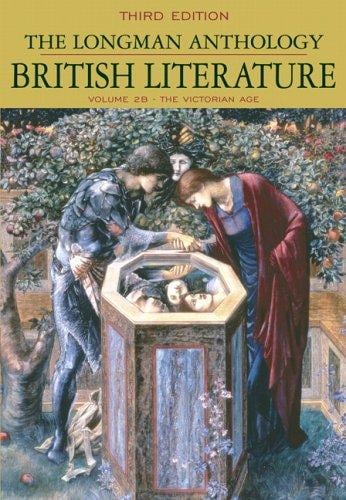
The Longman Anthology of British Literature: Volume 2B, The Victorian Age
0
0
Author Description
The Victorian Age: 1832-1901 Nothing characterizes Victorian society so much as its quest for self-definition. The sixty-three years of Victoria’s reign were marked by momentous and intimidating social changes, startling inventions, prodigious energies; the rapid succession of events produced wild prosperity and unthinkable poverty, humane reforms and flagrant exploitation, immense ambitions and devastating doubts. Between 1800 and 1850 the population doubled from nine to eighteen million, and Britain became the richest country on earth, the first urban industrial society in history. For some, it was a period of great achievement, deep faith, indisputable progress. For others, it was “an age of destruction,” religious collapse, vicious profiteering. To almost everyone it was apparent that, as Sir Henry Holland put it in 1858, “we are living in an age of transition.” VICTORIA AND THE VICTORIANS In an unpredictable, tumultuous era, the stern, staid figure of Queen Victoria came to represent stability and continuity. The adjective “Victorian” was first used in 1851 to celebrate the nation’s mounting pride in its institutions and commercial success. That year, the global predominance of British industry had emerged incontestably at the original “world’s fair” in London, the “Great Exhibition of the Works of Industry of All Nations,” which Prince Albert helped organize. Arrayed for the world to see in a vast “Crystal Palace” of iron and glass, the marvels of British manufacture achieved a regal stature of their own and cast their allure upon the monarchy in turn. In the congratulatory rhetoric that surrounded the event, the conservative, retiring queen emerged as the durable symbol of her dynamic, aggressively businesslike realm. In succeeding decades, the official portraits of Queen Victoria, gradually aging, reflected her country's sense of its own maturation as a society and world power. Represented as a fairy-tale teenaged queen at her coronation in 1837, reclusive after Albert died in 1861, as the aged, venerated Widow of Windsor, she became a universal icon, prompting spectacles of the Golden and Diamond Jubilees. Victoria died in 1901, after the longest reign in English history. The Victorians have left us a contradictory picture of themselves. On the one hand, they were phenomenally energetic, dedicated to the Gospel of Work and driven by a solemn sense of duty to the Public Good. In matters of character, Victorians prized respectability, earnestness, a sense of duty and public service, not only to material recompense, but to heavenly rewards as well. Much of the era's social conservatism, may be traced to the fear of change. They struggled to dominate the present moment in order to keep an uncertain future at bay. Few questioned that tremendous advances were taking place, but each new idea or discover seemed to have unexpected, distressing repercussions. The following pages introduce the Victorian period by looking at several key issues: the era's energy and invention, its doubts about religion and industrialism, its far-reaching social reforms, its conflicted fascination with Empire, the commercialization and expansion of the reading public, and the period's vigorous self-scrutiny in the mirror of literature.
Page Count:
1038
Publication Date:
2005-12-28
ISBN-10:
0321333950
ISBN-13:
9780321333957
Community Tags
Reader Comments
Share Your Thoughts
No comments yet. Be the first to share your thoughts!