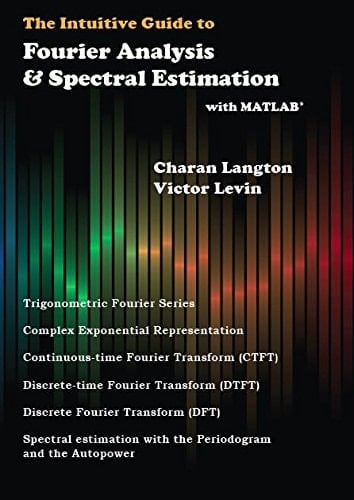
The Intuitive Guide to Fourier Analysis & Spectral Estimation with MATLAB
0
0
Author Description
This book will deepen your understanding of Fourier analysis making it easier to adavance to more complex topics in digital signal processing and data analysis in mathematics, physics, astronomy, bio-sciences, and financial engineering. With numerous examples, detailed explanations, and plots, the difficult concepts become clear and easy to grasp. We start with the development of Fourier series using harmonic sinusoids to represent periodic signals in continuous and discrete-time domains. From here, we examine the complex exponential to represent the Fourier series basis functions. Next, we describe the development of the continuous-time and discrete-time Fourier transform (DFT), the most practical type of the Fourier transform.CTFT and the DTFT for non-periodic signals. We show how the DTFT is modified to develop the Discrete Fourier Transform (DFT), the most practical type of the Fourier transform. We look at the properties and limitations of the DFT and its algorithmic cousin, the FFT.implementation, the Fast Fourier transform (FFT)We examine the use of Windows to reduce leakage effects due to truncation. We examine the applications of the DFT/FFT to random signals and the role of auto-correlation function in the development of the power spectrum. Lastly, we discuss methods of spectral power estimation. We focus on non-parametric power estimation of stationary random signals using the Periodogram and the Autopower.
Page Count:
304
Publication Date:
2017-01-01
ISBN-10:
0913063266
ISBN-13:
9780913063262