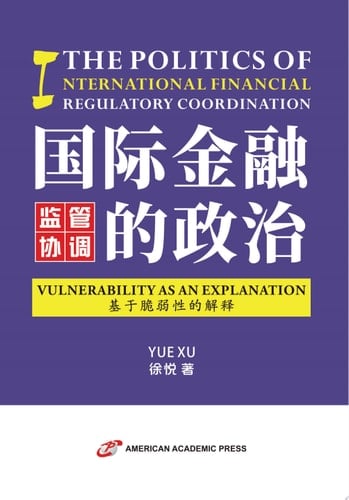
THE POLITICS OF INTERNATIONAL FINANCIAL REGULATORY COORDINATION VULNERABILITY AS AN EXPLANATION
0
0
Author Description
The 2008 global financial crisis is followed by regulatory reforms in many jurisdictions, which increased the demand for international regulatory coordination. Coordination between the two global regulatory jurisdictions, the US and the EU, sometimes ends up with international standards closer to US preferences, while in some cases concludes with an agreement more favorable to the EU. Why does such a variation take place? Market power theory contends that market power shapes bargaining power and hence the outcomes of coordination. Two questions are yet to be answered and are discussed in this book. First, what shapes a jurisdiction’s market power? Market power is the function of relevant resources, and the willingness and capacity to use them. In Market power theory, market power is almost synonymous with market size, which this book counters with the proposition that greater market openness and more centralized regulatory authority also contribute to greater market power. Second, why does a jurisdiction’s bargaining power differ from another’s despite their symmetric market power? Built on market power theory, this book puts forward vulnerability as an explanation. Vulnerability is dependent on a jurisdiction’s loss or its costs of using an alternative option when coordination fails. Between players with symmetric market power, the one with relative vulnerability has a greater aversion to risks, and therefore has weakened bargaining power. Outcomes of coordination tend to deviate from its original preferences.
Page Count:
195
Publication Date:
2023-02-15
ISBN-10:
1631814052
ISBN-13:
9781631814051