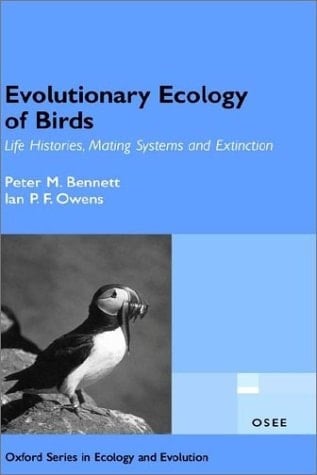
Evolutionary Ecology of Birds: Life Histories, Mating Systems and Extinction (Oxford Series in Ecology and Evolution)
0
0
Author Description
Review "This book contains a wealth of new analyses, points out intriguing unsolved questions, and for that reason is highly appropriate for a series aimed at senior graduate students and above... I believe this book may well act as a catalyst for an explosion of studies in the area of comparativeevolutionary ecology." -- Professor Tim Birkhead, University of Sheffield"I think this is a marvellous book - the most exciting I have read for a long time... A terrific text for both final year undergraduates and for graduate courses, as well as required reading for academics working in the field." -- Professor Nick Davies, University of Cambridge"[A] useful overview of the strengths and weaknesses of the comparative method...stimulates thinking about how we can learn more about variation in avian life histories and mating systems."--Nature"This is an important book.... [Bennett and Owens] have written a wonderfully stimulating book which... is a landmark in bird biology and should be read by all ornithologists."--Ibis Product Description Birds show bewildering diversity in their life histories, mating systems and risk of extinction. Why do albatrosses delay reproduction for the first 12 years of their life while zebra finches breed in their first year? Why are fairy-wrens so sexually promiscuous while swans show lifelongmonogamy? Why are over a quarter of parrot species threatened with global extinction while woodpeckers and cuckoos remain secure? Some of these topics are classic problems in natural and sexual selection, while others have arisen in the last decade, such as variation in genetic mating systems orextinction risk. Birds offer a unique opportunity for investigating these questions because they are exceptionally well-studied in the wild. By employing phylogenetic comparative methods and a database of up to 3,000 species, the authors identify the ecological and evolutionary basis of many ofthese intriguing questions. They also highlight remaining puzzles and identify a series of challenges for future investigation. This is the most comprehensive reappraisal of avian diversity since David Lack's classic "Ecological Adaptions for Breeding in Birds". It is also the most extensiveapplication of modern comparative methods yet undertaken. This novel approach demonstrates how an evolutionary perspective can reveal the general ecological processes that underpin contemporary avian diversity on a global scale. About the Author Peter Bennett is at the Institute of Zoology, Zoological Society of London, UK. Ian Owens is at the Department of Biology, Imperial College London at Silwood Park, Ascot, UK.
Page Count:
296
Publication Date:
2002-03-28
ISBN-10:
0198510888
ISBN-13:
9780198510888
Birds evolution
Community Tags
Reader Comments
Share Your Thoughts
No comments yet. Be the first to share your thoughts!