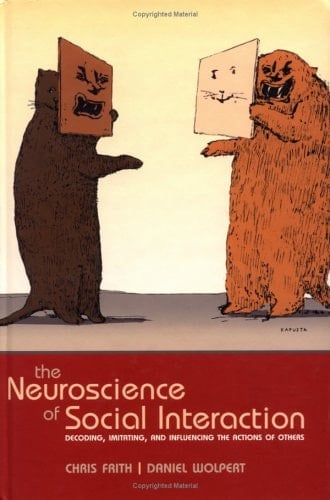
The Neuroscience of Social Interaction: Decoding, Imitating, and Influencing the Actions of Others
0
0
Author Description
Product DescriptionHumans, like other primates, are intensely social creatures. One of the major functions of our brains must be to enable us to be as skilful in social interactions as we are in our interactions with the physical world (eg recognizing objects and grasping them). Furthermore, any differencesbetween human brains and those of our nearest relatives, the great apes, are likely to be linked to our unique achievements in social interaction and communication rather than our motor or perceptual skills. In particular, humans have the ability to mentalize (or mind read), that is to perceive andcommunicate mental states, such as beliefs and desires. A key problem facing science therefore, is to uncover the biological mechanisms underlying our ability to read other minds and to show how these mechanisms evolved. To solve this problem we need to do experiments in which people (or animals) interact with one another rather than behaving inisolation. Such experiments are now being conducted in increasing numbers and many of the leading exponents of such experiments have contributed to this volume. 'The Neuroscience of Social Interactions' will be an important step in uncovering the biological mechanisms underlying social interactions- undoubtedly one of the major programs for neuroscience in the 21st century.About the AuthorProfessor Christopher Frith FRS, Functional Imaging Laboratory, Institute of Neurology, University College London Professor Daniel Wolpert, Institute of Neurology, University College London
Page Count:
360
Publication Date:
2004-01-01
ISBN-10:
0198529252
ISBN-13:
9780198529255
NEUROSCIENCES