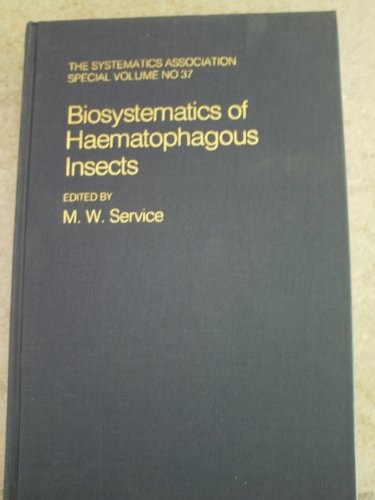
Biosystematics of Haematophagous Insects
0
0
As an Amazon Associate and affiliate partner, Menrva Books earns from qualifying purchases. Learn more
Author Description
With the growing awareness that many tropical diseases are transmitted by insects belonging to species complexes, epidemiologists have sought new methods for identifying the precise vector species involved. This information has a direct bearing on the understanding of such diseases as malaria, mosquito-borne filariasis, and scrub typhus. The contributors to this broad work discuss the taxonomic tools that are being used to unravel species complex problems, emphasizing the important role that classical taxonomy continues to play in this process. New techniques for identifying isomorphic species, including those employing chromosomes, pheromones, cuticular hydrocarbons, behavioral traits, electrophoresis, and DNA probes are presented. Phylogenetic relationships and coevolution, such as between Anoplura taxa and their eutherian mammal hosts, are examined by cladistic methods.
Menrva's Summary
THE THESIS
This volume investigates the critical role of biosystematics in identifying insect vector species responsible for the transmission of tropical diseases. Edited by M. W. Service, the text compiles research from various experts to address the limitations of traditional identification methods when dealing with isomorphic species complexes. The contributors argue that integrating classical taxonomic practices with modern molecular and behavioral techniques is essential for accurate epidemiological mapping and disease control strategies.
THE SCOPE MAP
What You Will Find
- Analysis of species complexes in vectors of malaria, filariasis, and scrub typhus.
- Methodologies for identification including electrophoresis, DNA probes, and cuticular hydrocarbon analysis.
- Examination of phylogenetic relationships and coevolutionary patterns between insects and hosts.
- Evaluation of the utility of behavioral traits and chromosomal studies in taxonomic classification.
THE AUTHORITY PERSPECTIVE
Experts recognize this volume as a significant reference for researchers and epidemiologists focused on vector-borne disease control. The text is noted for its technical rigor and its balanced approach to combining traditional morphological taxonomy with contemporary molecular diagnostics.
Page Count:
376
Publication Date:
1988-12-22
Publisher:
Oxford University Press
ISBN-10:
0198577095
ISBN-13:
9780198577096
Science
Epidemiology
Zoology
Insects as carriers of disease
Taxonomy
Entomology
Biology
Community Tags
Similar Books