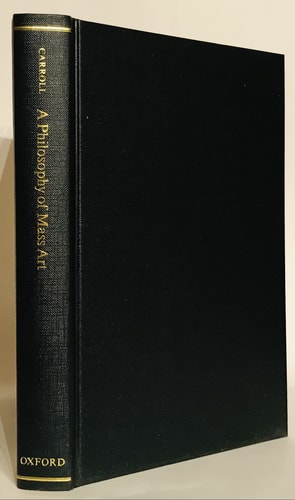
A Philosophy of Mass Art
0
0
As an Amazon Associate and affiliate partner, Menrva Books earns from qualifying purchases. Learn more
Author Description
We live in a world dominated by mass art. Movies, TV, pulp literature, comics, rock music―both broadcast and recorded―surround us everywhere in the industrialized world and beyond. However, despite the fact that for the majority mass art supplies the primary source of aesthetic experience, the area has been neglected entirely by analytic philosophers of art. In The Philosophy of Mass Art, Noel Carroll, a leading figures in the field of aesthetic philosophy, attempts to address that lacuna. He shows why philosophers have previously resisted and/or misunderstood mass art and he develops frameworks for understanding the relation of mass art to the emotions, morality, and ideology discussing the accounts of such theorists in the field as Collingwood, Adorno, Benajmin, McCluhan, and Fiske. Mixing conceptual analysis and many vivid examples, the author proposes the first significant attempt at a philosophy of mass art in the analytical tradition concluding there are strong grounds for approaching mass art in the same fashion as high art.
Menrva's Summary
THE THESIS
This work investigates the philosophical legitimacy of mass art, arguing that it warrants the same rigorous aesthetic analysis traditionally reserved for high art. Noel Carroll, a prominent philosopher of aesthetics, addresses the historical neglect of mass-produced media by analytic philosophers. By examining the intersection of mass art with emotion, morality, and ideology, he constructs a framework to evaluate works ranging from cinema to popular music. He critiques previous dismissive theories while establishing a new methodology for appreciating mass-produced cultural artifacts.
THE SCOPE MAP
What You Will Find
- A comprehensive critique of historical philosophical resistance toward mass media.
- Conceptual frameworks for analyzing the relationship between mass art and human emotion.
- Comparative studies of influential theorists including Collingwood, Adorno, Benjamin, McLuhan, and Fiske.
- A systematic argument for applying high-art analytical standards to popular cultural forms.
THE AUTHORITY PERSPECTIVE
Critics and scholars recognize this work as a foundational text that successfully bridges the gap between analytic philosophy and popular culture studies. Readers frequently note the clarity of the prose despite the complex theoretical arguments presented throughout the chapters.
Page Count:
440
Publication Date:
1998-02-19
Publisher:
Oxford University Press
ISBN-10:
0198711298
ISBN-13:
9780198711292
Philosophy
Mass media
Art Theory
Aesthetics
Community Tags
Similar Books