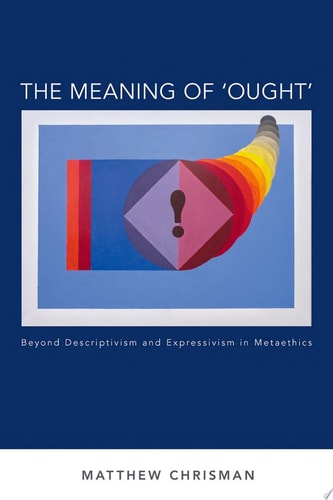
The Meaning of 'Ought'
0
0
As an Amazon Associate and affiliate partner, Menrva Books earns from qualifying purchases. Learn more
Author Description
The Word 'ought' Is One Of The Core Normative Terms, But It Is Also A Modal Word. In This Book Matthew Chrisman Develops A Careful Account Of The Semantics Of 'ought' As A Modal Operator, And Uses This To Motivate A Novel Inferentialist Account Of Why Ought-sentences Have The Meaning That They Have. This Is A Metanormative Account That Agrees With Traditional Descriptivist Theories In Metaethics That Specifying The Truth-conditions Of Normative Sentences Is A Central Part Of The Explanation Of Their Meaning. But Chrisman Argues That This Leaves Important Metasemantic Questions About What It Is In Virtue Of Which Ought-sentences Have The Meanings That They Have Unanswered. His Appeal To Inferentialism Aims To Provide A Viable Anti-descriptivist But Also Anti-expressivist Answer To These Questions. This Is A Remarkably Bold And Interesting Book. Chrisman Challenges Nothing Less Than The Entire Conceptual Framework Within Which Most Previous Metaethics (and Indeed, Much Other Contemporary Philosophy) Has Been Done, And Advances A Very Ambitious Rethinking Of The Theoretical Space. It's Not Only Ambitious, But Also Extremely Imaginative And Smart, And Chrisman's Scholarship Is At A Rare Level, As He Has Assimilated A Literature That Is Unusually Broad Both In Terms Of Field And Historical Scope.-stephen Finlay, Professor Of Philosophy, University Of Southern California
Menrva's Summary
THE THESIS
This book investigates the semantic and metasemantic foundations of the word 'ought' to determine how normative sentences acquire their specific meanings. Matthew Chrisman, a scholar in the field of metaethics, evaluates the limitations of traditional descriptivist theories regarding normative language. He proposes an inferentialist framework that seeks to bridge the gap between descriptivist truth-conditions and the underlying mechanisms that give normative discourse its unique function. By positioning 'ought' as a modal operator, the author constructs a metanormative argument that challenges established conceptual boundaries in contemporary philosophy.
THE SCOPE MAP
What You Will Find
- A detailed semantic analysis of 'ought' as a modal operator within normative language.
- An inferentialist methodology designed to explain the meaning of normative sentences without relying solely on descriptivism or expressivism.
- A critical review of historical and contemporary metaethical literature regarding the truth-conditions of normative statements.
- A proposed restructuring of the theoretical space in metaethics to address unanswered metasemantic questions.
THE AUTHORITY PERSPECTIVE
Experts in the field recognize this work as a significant contribution to metaethics that demands a high level of engagement with complex linguistic and philosophical concepts. Readers frequently note the academic density of the prose, which is intended for advanced students and professional philosophers interested in the mechanics of normative language.
Page Count:
320
Publication Date:
2015-01-01
Publisher:
Oxford University Press
ISBN-10:
0199363013
ISBN-13:
9780199363018
Philosophy
Linguistics
Ethics
Logic
Metaethics
Semantics
Community Tags
Other Editions(2)

Similar Books