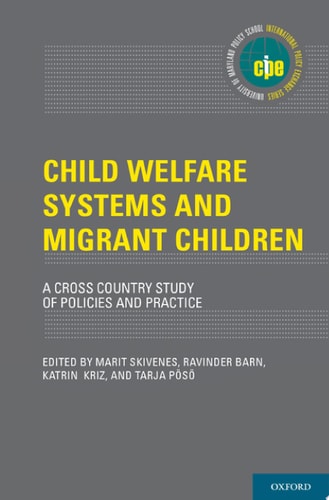
Child Welfare Systems and Migrant Children: A Cross Country Study of Policies and Practice
0
0
As an Amazon Associate and affiliate partner, Menrva Books earns from qualifying purchases. Learn more
Author Description
Child Welfare Systems and Migrant Children examines where, why and to what extent immigrant children are represented in the child welfare system in different countries. These countries include Australia/New Zealand, Belgium/the Netherlands, England, Estonia, Canada, Finland, Italy, Germany, Spain, Norway, and the United States--all of them having different child welfare philosophies and systems as well as histories and practices in immigration. By comparing policies and practices in child welfare systems (and welfare states), especially in terms of how they conceptualize and deal with immigrant children and their families, we address an immensely important and pressing issue in modern societies. Immigrants in the child welfare system are a critical issue and they seem to face serious challenges that are evident across countries. These are challenges related to lack of language proficiency, lack of knowledge about cultural and social aspects and about the public systems of the destination country. Perhaps most relevantly, the challenges may include collisions of ideas and beliefs about how to raise children, about children's place in the family and society, and about children's rights.
Menrva's Summary
THE THESIS
This book investigates the systemic representation of immigrant children within child welfare frameworks across diverse nations to understand how varying welfare philosophies impact policy and practice. The authors, Katrin Kriz, Marit Skivenes, and Ravinder Barn, utilize a comparative methodology to analyze how different countries conceptualize the needs and rights of migrant families. By examining the intersection of immigration history and child protection systems, the text argues that structural challenges—such as language barriers and cultural dissonance—create consistent difficulties for migrant populations regardless of the specific national context.
THE SCOPE MAP
What You Will Find
- Comparative analysis of child welfare systems in Australia, New Zealand, Belgium, the Netherlands, England, Estonia, Canada, Finland, Italy, Germany, Spain, Norway, and the United States.
- Examination of the collision between immigrant child-rearing beliefs and host country social norms.
- Analysis of systemic barriers including language proficiency and lack of institutional knowledge.
Scope Limits
- The study does not provide a singular universal policy solution for all nations.
- It does not offer an exhaustive longitudinal history of every individual country's immigration policy.
THE AUTHORITY PERSPECTIVE
Experts identify this work as a significant contribution to comparative social policy, noting its utility for researchers and practitioners navigating the complexities of multicultural child protection. Readers frequently highlight the academic rigor of the cross-country analysis as a foundational resource for understanding the intersection of migration and state intervention.
Page Count:
304
Publication Date:
2014-01-01
Publisher:
Oxford University Press
ISBN-10:
0190205318
ISBN-13:
9780190205317
Social Science
International relations
Public Policy
Sociology
Migration Studies
Introduction to Social WorkWelfare
Child Welfare
Community Tags
Similar Books