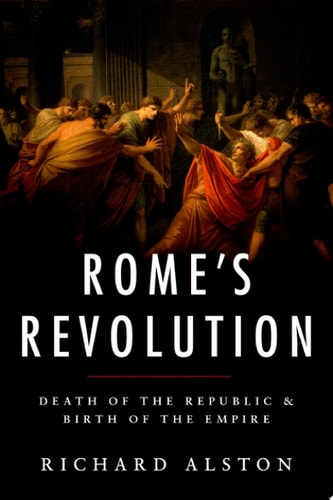
Rome's Revolution
0
0
As an Amazon Associate and affiliate partner, Menrva Books earns from qualifying purchases. Learn more
Author Description
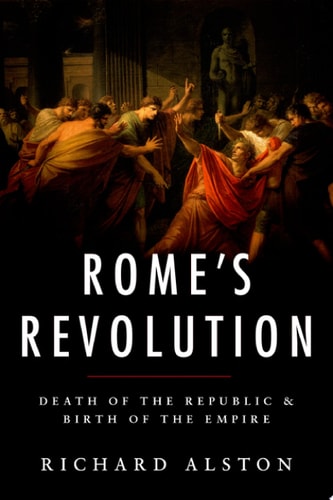
On March 15th, 44 BC a group of senators stabbed Julius Caesar, the dictator of Rome. By his death, they hoped to restore Rome's Republic. Instead, they unleashed a revolution. By December of that year, Rome was plunged into a violent civil war. Three men--Mark Antony, Lepidus, and Octavian--emerged as leaders of a revolutionary regime, which crushed all opposition. In time, Lepidus was removed, Antony and Cleopatra were dispatched, and Octavian stood alone as sole ruler of Rome. He became Augustus, Rome's first emperor, and by the time of his death in AD 14 the 500-year-old Republic was but a distant memory and the birth of one of history's greatest empires was complete. Rome's Revolution provides a riveting narrative of this tumultuous period of change. Historian Richard Alston digs beneath the high politics of Cicero, Caesar, Antony, and Octavian to reveal the experience of the common Roman citizen and soldier. He portrays the revolution as the crisis of a brutally competitive society, both among the citizenry and among the ruling class whose legitimacy was under threat. Throughout, he sheds new light on the motivations that drove men to march on their capital city and slaughter their compatriots. He also shows the reasons behind and the immediate legacy of the awe inspiringly successful and ruthless reign of Emperor Augustus. An enthralling story of ancient warfare, social upheaval, and personal betrayal, Rome's Revolution offers an authoritative new account of an epoch which still haunts us today.
Menrva's Summary
THE THESIS
This work investigates how the assassination of Julius Caesar catalyzed the collapse of the Roman Republic and the subsequent rise of the Augustan Empire. Richard Alston, a historian specializing in the Roman world, utilizes a combination of primary source analysis and social history to examine the transition from a competitive republican system to autocratic rule. He argues that the revolution was not merely a top-down political shift, but a systemic crisis rooted in the brutal social competition prevalent across all levels of Roman society.
THE SCOPE MAP
What You Will Find
- A detailed timeline of the civil wars following the Ides of March in 44 BC.
- Analysis of the political maneuvering between the Second Triumvirate and their rivals.
- Examination of the lived experiences of common soldiers and citizens during the transition.
- Evaluation of the consolidation of power under Augustus.
Scope Limits
- The text focuses primarily on the late Republican and early Imperial transition period.
- It does not provide an exhaustive military history of every campaign, prioritizing social and political context instead.
THE AUTHORITY PERSPECTIVE
Historians and scholars recognize this text for its ability to bridge the gap between high-level political biography and the social history of the Roman populace. Readers frequently note that the prose is accessible while maintaining a rigorous academic standard for historical inquiry.
Page Count:
336
Publication Date:
2015-01-01
Publisher:
Oxford University Press
ISBN-10:
0190231602
ISBN-13:
9780190231606
Biography
History
Military History
Ancient - Rome
Community Tags
Similar Books