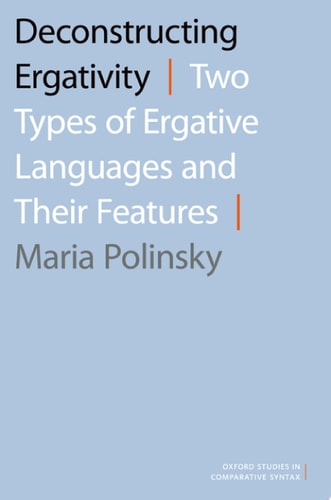
Deconstructing Ergativity
0
0
As an Amazon Associate and affiliate partner, Menrva Books earns from qualifying purchases. Learn more
Author Description
Nominative-accusative And Ergative Are Two Common Alignment Types Found Across Languages. In The Former Type, The Subject Of An Intransitive Verb And The Subject Of A Transitive Verb Are Expressed The Same Way, And Differently From The Object Of A Transitive. In Ergative Languages, The Subject Of An Intransitive And The Object Of A Transitive Appear In The Same Form, The Absolutive, And The Transitive Subject Has A Special, Ergative, Form. Ergative Languages Often Follow Very Different Patterns, Thus Evading A Uniform Description And Analysis. A Simple Explanation For That Has To Do With The Idea That Ergative Languages, Much As Their Nominative-accusative Counterparts, Do Not Form A Uniform Class. In This Book, Maria Polinsky Argues That Ergative Languages Instantiate Two Main Types, The One Where The Ergative Subject Is A Prepositional Phrase (pp-ergatives) And The One With A Noun-phrase Ergative. Each Type Is Internally Consistent And Is Characterized By A Set Of Well-defined Properties. The Book Begins With An Analysis Of Syntactic Ergativity, Which As Polinsky Argues, Is A Manifestation Of The Pp-ergative Type. Polinsky Discusses Diagnostic Properties That Define Pps In General And Then Goes To Show That A Subset Of Ergative Expressions Fit The Profile Of Pps. Several Alternative Analyses Have Been Proposed To Account For Syntactic Ergativity; The Book Presents And Outlines These Analyses And Offers Further Considerations In Support Of The Pp-ergativity Approach. The Book Then Discusses The Second Type, Dp-ergative Languages, And Traces The Diachronic Connection Between The Two Types. The Book Includes Two Chapters Illustrating Paradigm Pp-ergative And Dp-ergative Languages: Tongan And Tsez. The Data Used In These Descriptions Come From Polinsky's Original Fieldwork Hence Presenting New Empirical Facts From Both Languages.
Menrva's Summary
THE THESIS
This book investigates the structural diversity of ergative languages to determine why they resist a uniform linguistic classification. Maria Polinsky, a prominent linguist, utilizes extensive cross-linguistic data and original fieldwork to argue that ergative languages fall into two distinct categories: those where the ergative subject functions as a prepositional phrase (PP-ergatives) and those where it functions as a noun phrase (DP-ergatives). By establishing this binary framework, the author provides a systematic method for analyzing syntactic ergativity and its diachronic development.
THE SCOPE MAP
What You Will Find
- A comparative analysis of PP-ergative and DP-ergative structures.
- Diagnostic criteria for identifying prepositional phrases within ergative constructions.
- Detailed case studies of Tongan and Tsez based on original field research.
- An overview of alternative theoretical approaches to syntactic ergativity.
Scope Limits
- The analysis focuses primarily on the proposed PP-ergative and DP-ergative dichotomy rather than exhaustive coverage of every known ergative language.
- The text assumes a foundational understanding of generative syntax and morphological alignment.
THE AUTHORITY PERSPECTIVE
Linguists and researchers frequently cite this work as a significant contribution to the study of ergativity and syntactic typology. Readers often note the academic density of the prose, which is intended for advanced students and professionals in the field of theoretical linguistics.
Page Count:
304
Publication Date:
2016-01-01
Publisher:
Oxford University Press
ISBN-10:
0190256605
ISBN-13:
9780190256609
Syntax
Morphology
Linguistics
Academic
Community Tags
Similar Books