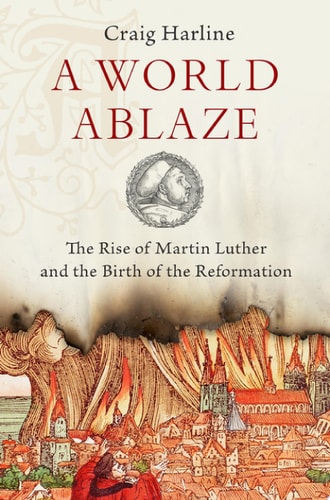
A World Ablaze: The Rise of Martin Luther and the Birth of the Reformation
0
0
As an Amazon Associate and affiliate partner, Menrva Books earns from qualifying purchases. Learn more
Author Description
October 2017 marks five hundred years since Martin Luther nailed his 95 theses to the church door in Wittenberg and launched the Protestant Reformation. At least, that's what the legend says. But with a figure like Martin Luther, who looms so large in the historical imagination, it's hard to separate the legend from the life, or even sometimes to separate assorted legends from each other. Over the centuries, Luther the man has given way to Luther the icon, a polished bronze figure on a pedestal. In A World Ablaze, Craig Harline introduces us to the flesh-and-blood Martin Luther. Harline tells the riveting story of the first crucial years of the accidental crusade that would make Luther a legendary figure. He didn't start out that way; Luther was a sometimes-cranky friar and professor who worried endlessly about the fate of his eternal soul. He sought answers in the Bible and the Church fathers, and what he found distressed him even more -- the way many in the Church had come to understand salvation was profoundly wrong, thought Luther, putting millions of souls, not least his own, at risk of damnation. His ideas would pit him against numerous scholars, priests, bishops, princes, and the Pope, even as others adopted or adapted his cause, ultimately dividing the Church against itself. A World Ablaze is a tale not just of religious debate but of political intrigue, of shifting alliances and daring escapes, with Luther often narrowly avoiding capture, which might have led to execution. The conflict would eventually encompass the whole of Christendom and served as the crucible in which a new world was forged. The Luther we find in these pages is not a statue to be admired but a complex figure -- brilliant and volatile, fretful and self-righteous, curious and stubborn. Harline brings out the immediacy, uncertainty, and drama of his story, giving readers a sense of what it felt like in the moment, when the ending was still very much in doubt.
Menrva's Summary
THE THESIS
This work investigates how Martin Luther transformed from an anxious, obscure friar into the central figure of a religious and political upheaval that permanently fractured Western Christendom. Craig Harline, a historian specializing in early modern Europe, utilizes primary source accounts and contemporary records to strip away centuries of hagiography. He argues that the Reformation was not a pre-planned movement but an accidental crusade driven by Luther's personal spiritual crises and the volatile political climate of the sixteenth century.
THE SCOPE MAP
What You Will Find
- A chronological account of the first crucial years of the Reformation starting in 1517.
- Analysis of the political maneuvering between the Holy Roman Empire, the Papacy, and regional German princes.
- Examination of Luther's internal psychological state and his evolving theological arguments.
Scope Limits
- The text focuses primarily on the early years of the movement rather than the long-term theological developments of later Protestantism.
- It does not provide an exhaustive biography of Luther's entire life, concentrating instead on the period of his most intense conflict.
THE AUTHORITY PERSPECTIVE
Scholars and readers frequently note the accessible, narrative-driven prose that avoids overly dense academic jargon while maintaining historical rigor. Experts highlight this as a successful attempt to humanize a historical icon by focusing on the uncertainty and immediate stakes of the era.
Page Count:
312
Publication Date:
2017-01-01
Publisher:
Oxford University Press
ISBN-10:
0190275200
ISBN-13:
9780190275204
History
Biography
Religion
Christianity
European History
Reformation
Community Tags
Similar Books