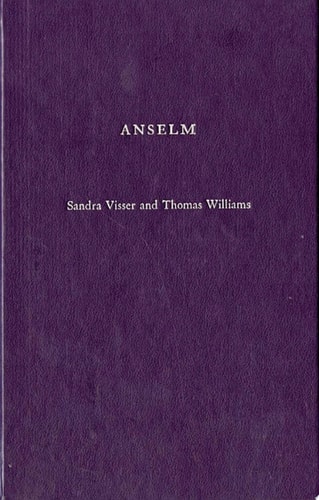
Anselm
0
0
As an Amazon Associate and affiliate partner, Menrva Books earns from qualifying purchases. Learn more
Author Description
Sandra Visser and Thomas Williams offer a brief, accessible introduction to the life and thought of Saint Anselm (c. 1033-1109). Anselm, Archbishop of Canterbury for the last sixteen years of his life, is one of the foremost philosopher-theologians of the Middle Ages. His keen and rigorous thinking earned him the title "The Father of Scholasticism," and his influence is discernible in figures as various as Thomas Aquinas, John Duns Scotus, the voluntarists of the late-thirteenth and fourteenth centuries, and the Protestant reformers. In part I of this book, Visser and Williams lay out the framework of Anselm's thought: his approach to what he calls "the reason of faith," his account of thought and language, and his theory of truth. Part II focuses on Anselm's account of God and the divine attributes, and it shows how Anselm applies his theory of language and thought to develop a theological semantics that at once respects divine transcendence and allows for the possibility of divine rational knowledge. In Part III, Visser and Williams turn from the heavenly to the animal. They elucidate Anselm's theory of modality and his understanding of free choice, an idea that was, for Anselm, embedded in his conception of justice. The book concludes with a discussion of Incarnation, Atonement, and original sin, as the authors examine Anselm's argument that the death of a God-man is the only possible remedy for human injustice.
Menrva's Summary
THE THESIS
This book investigates the philosophical and theological framework of Saint Anselm of Canterbury to determine how his rigorous logic shaped the development of Scholasticism. Sandra Visser and Thomas Williams, both scholars of medieval philosophy, utilize Anselm's primary texts to reconstruct his approach to faith and reason. They argue that Anselm's work provides a coherent system that bridges divine transcendence with human rational inquiry. By examining his theories on language, truth, and modality, the authors demonstrate the enduring influence of his thought on later medieval and Reformation-era thinkers.
THE SCOPE MAP
What You Will Find
- A comprehensive analysis of Anselm's theological semantics and theory of truth.
- An examination of his views on free choice, justice, and modality.
- A detailed breakdown of his arguments regarding the Incarnation and Atonement.
Scope Limits
- The text does not provide a exhaustive biographical account of Anselm's political life as Archbishop.
- It does not cover the full historical reception of his work beyond the late medieval period.
THE AUTHORITY PERSPECTIVE
Experts identify this work as a clear and accessible entry point for students of medieval philosophy. Readers frequently note that the authors successfully distill complex scholastic arguments into a manageable format for those new to Anselm's thought.
Page Count:
315
Publication Date:
2008-01-01
Publisher:
Oxford University Press
ISBN-10:
0190294868
ISBN-13:
9780190294861
Religion
History
Biography
Philosophy
Scholasticism
Theology
Christian Thought
European History
Community Tags
Similar Books