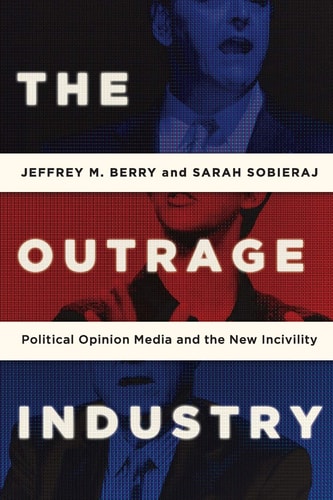
The Outrage Industry: Political Opinion Media and the New Incivility
0
0
As an Amazon Associate and affiliate partner, Menrva Books earns from qualifying purchases. Learn more
Author Description
In early 2012, conservative radio host Rush Limbaugh claimed that Sandra Fluke, a Georgetown University law student who advocated for insurance coverage of contraceptives, "wants to be paid to have sex." Over the next few days, Limbaugh attacked Fluke personally, often in crude terms, while a powerful backlash grew, led by organizations such as the National Organization for Women. But perhaps what was most notable about the incident was that it wasn't unusual. From Limbaugh's venomous attacks on Fluke to liberal radio host Mike Malloy's suggestion that Bill O'Reilly "drink a vat of poison... and choke to death," over-the-top discourse in today's political opinion media is pervasive.Anyone who observes the skyrocketing number of incendiary political opinion shows on television and radio might conclude that political vitriol on the airwaves is fueled by the increasingly partisan American political system. But in The Outrage Industry Jeffrey M. Berry and Sarah Sobieraj show how the proliferation of outrage-the provocative, hyperbolic style of commentary delivered by hosts like Ed Schultz, Bill O'Reilly, and Sean Hannity- says more about regulatory, technological, and cultural changes, than it does about our political inclinations.Berry and Sobieraj tackle the mechanics of outrage rhetoric, exploring its various forms such as mockery, emotional display, fear mongering, audience flattery, and conspiracy theories. They then investigate the impact of outrage rhetoric-which stigmatizes cooperation and brands collaboration and compromise as weak-on a contemporary political landscape that features frequent straight-party voting in Congress. Outrage tactics have also facilitated the growth of the Tea Party, a movement which appeals to older, white conservatives and has dragged the GOP farther away from the demographically significant moderates whose favor it should be courting. Finally, The Outrage Industry examines how these shows sour our own political lives, exacerbating an
Menrva's Summary
THE THESIS
This book investigates the structural and cultural drivers behind the rise of hyperbolic, aggressive rhetoric in contemporary American political media. Jeffrey M. Berry and Sarah Sobieraj, both established scholars in political science and sociology, utilize a rigorous content analysis of television and radio programs to challenge the assumption that political vitriol is merely a reflection of partisan polarization. They argue that the prevalence of outrage is a product of specific regulatory shifts, technological advancements, and the commercial incentives of the media industry rather than a direct consequence of public political sentiment.
THE SCOPE MAP
What You Will Find
- A comprehensive analysis of outrage tactics including mockery, fear-mongering, and emotional display.
- An examination of the media landscape following the deregulation of the airwaves.
- Data-driven insights into how media discourse influences legislative behavior and party dynamics.
Scope Limits
- The study focuses primarily on the American media environment and does not provide a comparative analysis of international political discourse.
- The analysis does not cover the evolution of social media platforms as a primary driver of outrage, focusing instead on traditional broadcast and cable media.
THE AUTHORITY PERSPECTIVE
Experts in political communication frequently cite this work as a foundational text for understanding the mechanics of modern media polarization. Readers often note the academic density of the prose, which provides a thorough, evidence-based framework for analyzing the influence of opinion-based media on the democratic process.
Page Count:
288
Publication Date:
2016-08-01
Publisher:
Oxford University Press
ISBN-10:
0190498463
ISBN-13:
9780190498467
Public opinion
Mass media
Television in politics
Sociology
Communication
Media Studies
American Politics
Community Tags
Other Editions(2)
Similar Books





Reader Comments
Share Your Thoughts
No comments yet. Be the first to share your thoughts!