Author Description
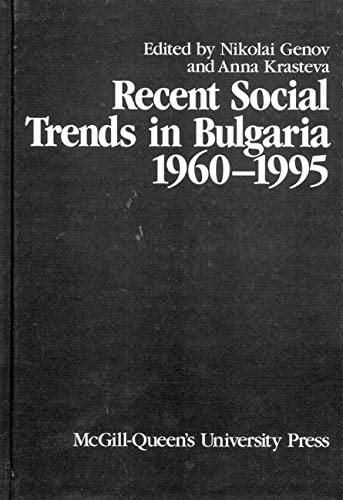
Since the 1960s Bulgaria has seen many changes, including rapid modernisation and the transition from a communist economy to a market economy. It has also faced accelerated social change. Recent Social Trends in Bulgaria, 1960–1995, the seventh volume in the Comparative Charting of Social Change series, provides an in-depth look at the rapid modernisation that has swept the country since 1960. The introduction, by Nikolai Genov, looks at the challenges posed by two transformations: the experiment with communism, which ended in failure, and the current transition to a market economy and pluralist politics. Genov concludes that the major reason for Bulgaria's critical situation is the powerlessness of its state institutions. Considering life-style, fertility, leisure and consumption, inequality, religion, economic institutions, ethnicity, norms of conduct, and family, as well as other trends, Recent Social Trends in Bulgaria, 1960–1995 is the first comprehensive presentation of the major transformations that characterise Bulgaria at the turn of the century. The contributors not only consider a broad range of social phenomena but provide an in-depth analysis of social change. This national profile provides more data supporting the hypothesis of diversification, rather than convergence, in modern societies, a hypothesis proposed by the Comparative Charting of Social Change group after documenting social change in many countries. Nikolai Gevov is a professor at the Institute of Sociology and a member of the Bulgarian Academy of Sciences. Anna Krasteva is a professor at the Institute of Philosophy, University of Sophia.
Page Count:
494
Publication Date:
2001-01-01
ISBN-10:
0773520228
ISBN-13:
9780773520226