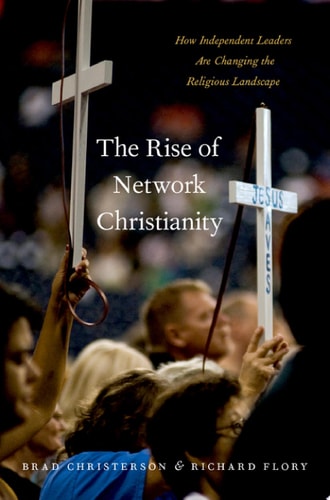
The Rise of Network Christianity: How Independent Leaders Are Changing the Religious Landscape
0
0
As an Amazon Associate and affiliate partner, Menrva Books earns from qualifying purchases. Learn more
Author Description
Why, when traditionally organized religious groups are seeing declining membership and participation, are networks of independent churches growing so explosively? Drawing on in-depth interviews with leaders and participants, The Rise of Network Christianity explains the social forces behind the fastest-growing form of Christianity in the U.S., which Brad Christerson and Richard Flory have labeled "Independent Network Charismatic." This form of Christianity emphasizes aggressive engagement with the supernatural-including healing, direct prophecies from God, engaging in "spiritual warfare" against demonic spirits--and social transformation. Christerson and Flory argue that macro-level social changes since the 1970s, including globalization and the digital revolution, have given competitive advantages to religious groups organized as networks rather than traditionally organized congregations and denominations. Network forms of governance allow for experimentation with controversial supernatural practices, innovative finances and marketing, and a highly participatory, unorthodox, and experiential faith, which is attractive in today's unstable religious marketplace. Christerson and Flory hypothesize that as more religious groups imitate this type of governance, religious belief and practice will become more experimental, more orientated around practice than theology, more shaped by the individual religious "consumer," and authority will become more highly concentrated in the hands of individuals rather than institutions. Network Christianity, they argue, is the future of Christianity in America.
Menrva's Summary
THE THESIS
This book investigates why independent, network-based Christian organizations are experiencing rapid growth while traditional denominations face declining membership. Authors Brad Christerson and Richard Flory, both sociologists, utilize a framework of organizational theory and social change to analyze the rise of the Independent Network Charismatic (INC) movement. They argue that macro-level shifts, such as globalization and digital connectivity, favor decentralized, network-based governance structures that prioritize experiential faith and individual authority over institutional hierarchy.
THE SCOPE MAP
What You Will Find
- Analysis of the Independent Network Charismatic (INC) movement in the United States
- Examination of organizational structures that favor network governance over traditional denominations
- Investigation into the role of supernatural practices, such as healing and spiritual warfare, in religious growth
- Discussion of how digital technology and globalization influence religious marketing and finance
Scope Limits
- The study focuses primarily on the American religious landscape and may not fully account for global variations of these movements
- The analysis prioritizes organizational and sociological factors over theological or doctrinal debates
THE AUTHORITY PERSPECTIVE
Scholars and sociologists of religion recognize this work as a significant contribution to understanding the shifting landscape of American Christianity. Readers frequently note the clarity of the authors' sociological framework and the depth of their qualitative research into independent church leadership.
Page Count:
193
Publication Date:
2017-01-01
Publisher:
Oxford University Press
ISBN-10:
019063569X
ISBN-13:
9780190635695
Religion
Christianity
Charismatic Christianity
Sociology of Religion
Pentecostalism
Community Tags
Similar Books