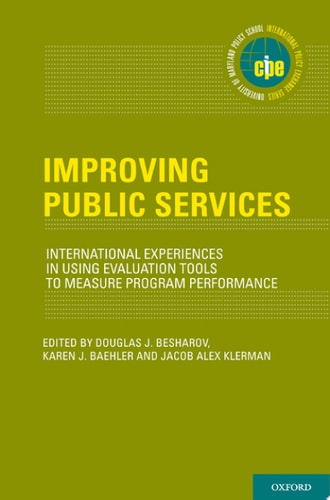
Improving Public Services: International Experiences in Using Evaluation Tools to Measure Program Performance
0
0
As an Amazon Associate and affiliate partner, Menrva Books earns from qualifying purchases. Learn more
Author Description
The government performance movement has been in full swing for decades around the world. So, why do so many public programs and organizations continue to underperform? A major reason is that measuring the types of performance that people value most -- real outcomes for citizens -- continues to be an elusive goal. And why is performance measurement so difficult? Because performance managers have not taken full advantage of the tools and knowledge available in the field of program evaluation; the worlds of performance measurement and program evaluation have much to learn from each other, but they remain largely separate for reasons of history, politics, and inertia.Improving Public Services spotlights recent advances in the theory and practice of performance measurement with potential to bridge the divide. As the text's essays, case studies, and comparative analyses demonstrate, many of the challenges to outcome-based performance measurement are similar across national and cultural boundaries. And many of these challenges are amenable to solutions drawn from program evaluation, especially program theory as captured in logic models.Key issues addressed include designing and implementing high-performance contracts, using administrative data to measure performance and evaluate program effectiveness, minimizing the unintended consequences of performance-based incentive schemes, measuring qualities of governance as well as service delivery, and fitting performance systems to different institutional settings. The authors offer insights relevant to charitable organizations, private service providers, international bodies, municipalities, states, and national governments in developed, developing, and transitional countries. As the global debate over performance management rages on, this volume points to promising directions for future research and practice at the intersection of program evaluation and outcome-based public management.
Menrva's Summary
THE THESIS
How can governments and public organizations effectively bridge the divide between performance measurement and program evaluation to improve real-world outcomes for citizens? The authors, Douglas J. Besharov, Jacob Alex Klerman, and Karen J. Baehler, utilize their extensive backgrounds in public policy and social research to argue that performance management often fails due to a lack of integration with rigorous evaluation methodologies. By synthesizing international case studies and comparative analyses, they propose that logic models and program theory are essential tools for overcoming institutional inertia and designing more effective public service delivery systems.
THE SCOPE MAP
What You Will Find
- Comparative analyses of performance measurement systems across various national and cultural contexts.
- Methodologies for implementing high-performance contracts and utilizing administrative data.
- Strategies for mitigating unintended consequences in incentive-based schemes.
- Frameworks for assessing governance quality alongside service delivery metrics.
Scope Limits
- The text does not provide a universal, one-size-fits-all manual for every specific government agency.
- It does not focus on the political lobbying processes that precede the implementation of these evaluation tools.
THE AUTHORITY PERSPECTIVE
Experts in public administration frequently cite this volume as a critical resource for understanding the intersection of performance management and program evaluation. Readers often note the academic density of the prose, which is tailored for policy practitioners, researchers, and students of public management.
Page Count:
360
Publication Date:
2017-01-20
Publisher:
Oxford University Press
ISBN-10:
0190646055
ISBN-13:
9780190646059
Governance
Management
Social service
Public Administration
Public Policy
Community Tags
Other Editions(2)
Similar Books





Reader Comments
Share Your Thoughts
No comments yet. Be the first to share your thoughts!