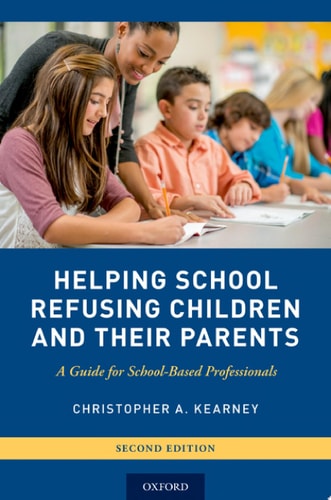
Helping School-Refusing Children and Their Parents: A Guide for School-Based Professionals
0
0
As an Amazon Associate and affiliate partner, Menrva Books earns from qualifying purchases. Learn more
Author Description
Children who miss substantial amounts of school pose one of the most vexing problems for school officials. In many cases, school personnel must assess these students and successfully help them to return to the academic setting. This can be difficult considering most school-based professionals are pressed for time and do not have access to proper resources. The information in this book can help school officials combat absenteeism and reduce overall dropout rates. Designed for guidance counselors, teachers, principals and deans, school psychologists, school-based social workers, and other school professionals, Helping School-Refusing Children and Their Parents outlines various strategies for helping children get back to school with less distress, all of which can be easily implemented in schools. This fully-updated second edition provides recommendations for a multi-tiered approach to school absenteeism that concentrates on prevention (Tier 1), early intervention for emerging cases (Tier 2), and more extensive intervention and systemic strategies for severe cases (Tier 3), with each tier based on empirically supported strategies grounded in scientific research. A chapter on assessment describes several methods for identifying school refusal behavior, including time-limited techniques for school officials who have little opportunity to conduct detailed evaluations. Worksheets for facilitating assessment are included and can easily be photocopied from the book. Other chapters provide advice for working collaboratively with parents, preventing relapse, and special issues. Topics such as poverty, homelessness, teenage pregnancy, violence, and school safety are also addressed, as are individualized education or 505 plans and consultation with other clinicians.
Menrva's Summary
THE THESIS
This book investigates the complex challenge of school refusal behavior and provides a structured, multi-tiered framework for school-based professionals to facilitate student re-engagement. Christopher A. Kearney, a recognized expert in the field of child psychology and school absenteeism, synthesizes empirical research into actionable protocols. The text argues that effective intervention requires a systematic approach that balances immediate assessment with long-term prevention strategies tailored to the specific needs of the student and their family.
THE SCOPE MAP
What You Will Find
- A multi-tiered system of support (MTSS) framework covering prevention, early intervention, and intensive systemic strategies.
- Practical assessment tools and worksheets designed for time-constrained school environments.
- Guidance on collaborative parent-school communication and relapse prevention.
- Analysis of external factors including poverty, homelessness, and school safety.
Scope Limits
- The text focuses primarily on school-based interventions rather than long-term clinical therapy conducted outside the educational setting.
- It does not provide exhaustive legal advice regarding specific regional educational mandates.
THE AUTHORITY PERSPECTIVE
Professionals in the field of education and school psychology frequently cite this work as a practical, evidence-based resource for managing absenteeism. Experts highlight the utility of the tiered intervention model for school staff who require immediate, actionable strategies to address complex student behavioral issues.
Page Count:
189
Publication Date:
2018-01-01
Publisher:
Oxford University Press
ISBN-10:
0190662077
ISBN-13:
9780190662073
Psychology
Professional Development
Education
Developmental Psychology
School Phobia
Social Work
Community Tags
Similar Books