Uncivil Warriors: The Lawyers' Civil War
0
0
As an Amazon Associate and affiliate partner, Menrva Books earns from qualifying purchases. Learn more
Author Description
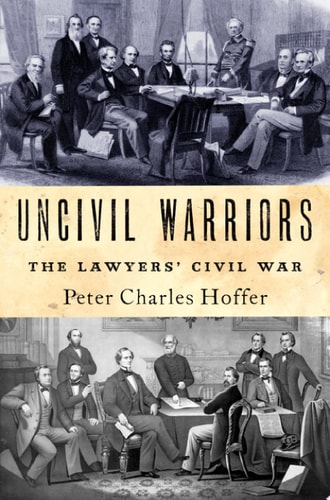
In the Civil War, the United States and the Confederate States of America engaged in combat to defend distinct legal regimes and the social order they embodied and protected. Depending on whose side's arguments one accepted, the Constitution either demanded the Union's continuance or allowed for its dissolution. After the war began, rival legal concepts of insurrection (a civil war within a nation) and belligerency (war between sovereign enemies) vied for adherents in federal and Confederate councils. In a "nation of laws," such martial legalism was not surprising. Moreover, many of the political leaders of both the North and the South were lawyers themselves, including Abraham Lincoln. These lawyers now found themselves at the center of this violent maelstrom. For these men, as for their countrymen in the years following the conflict, the sacrifices of the war gave legitimacy to new kinds of laws defining citizenship and civil rights. The eminent legal historian Peter Charles Hoffer's Uncivil Warriors focuses on these lawyers' civil war: on the legal professionals who plotted the course of the war from seats of power, the scenes of battle, and the home front. Both the North and the South had their complement of lawyers, and Hoffer provides coverage of each side's leading lawyers. In positions of leadership, they struggled to make sense of the conflict, and in the course of that struggle, began to glimpse of new world of law. It was a law that empowered as well as limited government, a law that conferred personal dignity and rights on those who, at the war's beginning, could claim neither in law. Comprehensive in coverage, Uncivil Warriors' focus on the central of lawyers and the law in America's worst conflict will transform how we think about the Civil War itself.
Menrva's Summary
THE THESIS
This work investigates how legal professionals on both sides of the American Civil War navigated the conflict's constitutional crises to redefine the relationship between government power and individual rights. Peter Charles Hoffer, a distinguished legal historian, utilizes primary source documentation and biographical analysis to examine how lawyer-politicians, including Abraham Lincoln, interpreted competing legal frameworks of insurrection and belligerency. The book argues that the war served as a catalyst for a fundamental shift in American jurisprudence, moving toward a system that increasingly recognized personal dignity and civil rights.
THE SCOPE MAP
What You Will Find
- Analysis of the legal arguments surrounding the Constitution, secession, and state sovereignty.
- Examination of the roles played by prominent Northern and Southern lawyers in shaping wartime policy.
- Discussion of the transition from antebellum legal norms to post-war definitions of citizenship.
Scope Limits
- The text does not provide a comprehensive military history of specific battles or tactical maneuvers.
- It does not focus on the experiences of non-legal professionals or the general infantry soldier's perspective.
THE AUTHORITY PERSPECTIVE
Scholars and legal historians frequently cite this work for its focused examination of the intersection between political leadership and constitutional theory during the 1860s. Readers often note that the prose maintains a high level of academic rigor while successfully contextualizing the legal debates within the broader narrative of the war.
Page Count:
240
Publication Date:
2018-01-01
Publisher:
Oxford University Press
ISBN-10:
0190851783
ISBN-13:
9780190851781
Biography
History
Political History
Professional Career & Trade
United States
Civil War
Secession
Legal History
American History