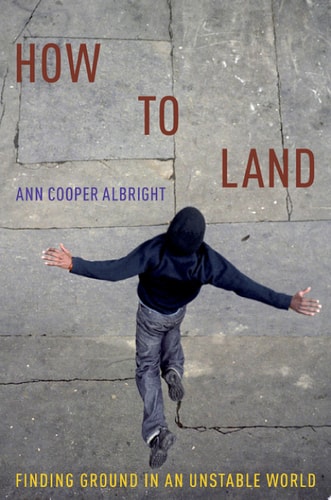
How to Land: Finding Ground in an Unstable World
0
0
As an Amazon Associate and affiliate partner, Menrva Books earns from qualifying purchases. Learn more
Author Description
How to Land: Finding Ground in an Unstable World foregrounds the importance of embodiment as a means of surviving the disorientation of our twenty-first century world. Linking somatics and politics, author Ann Cooper Albright argues that a renewed attention to gravity as both a metaphoric sensibility and a physical experience can help transform moments of personal disorientation into an opportunity to reflect on the important relationship between individual resiliency and communal responsibility. Long one of the nation's preeminent thinkers in dance studies, Albright asks how contemporary bodies are affected by repeated images of falling bodies, bombed-out buildings, and displaced peoples, as well as recurring evocations of global economies and governments in discursive free fall or dissolution. What kind of fear gets lodged in connective tissue when there is an underlying anxiety that certain aspects of our world are in danger of falling apart? To answer this question, she draws on analyses of perception from cognitive studies, tracing the discussions of meaning, body and language through the work of Sara Ahmed, Jean-Luc Nancy, and Shaun Gallagher, among others. In addition, she follows the past decade of debate in contemporary media concerning the implications of the weightless and two-dimensional social media exchanges on structures of attention and learning, as well as their effect on the personal growth and socialization of a generation of young adults. Each chapter interweaves discussions of movement actions with their cultural implications, documenting specific bodily experiences and then tracing their ideological ripples out through the world.
Menrva's Summary
THE THESIS
How can the physical experience of gravity and embodiment serve as a grounding mechanism for individuals navigating the disorientation of a volatile twenty-first-century world? Ann Cooper Albright, a prominent scholar in dance studies, utilizes her expertise in somatics to bridge the gap between physical movement and political consciousness. She argues that by consciously attending to the sensation of gravity, individuals can transform personal anxiety into a reflective practice that links individual resilience with broader communal responsibility.
THE SCOPE MAP
What You Will Find
- Analysis of cognitive studies regarding perception and body-language relationships
- Examination of the impact of digital media on attention spans and socialization
- Theoretical frameworks from thinkers including Sara Ahmed, Jean-Luc Nancy, and Shaun Gallagher
- Interdisciplinary synthesis of movement theory and political discourse
Scope Limits
- The text does not provide a clinical medical guide for physical therapy or trauma recovery
- It does not offer a comprehensive history of political science, focusing instead on the somatic implications of current events
THE AUTHORITY PERSPECTIVE
Scholars and readers in the fields of dance and performance studies identify this work as a significant contribution to the intersection of somatic practice and cultural theory. Experts frequently note the academic density of the prose, which requires a foundational understanding of contemporary philosophical discourse to fully engage with the author's arguments.
Page Count:
238
Publication Date:
2018-01-01
Publisher:
Oxford University Press
ISBN-10:
0190873701
ISBN-13:
9780190873707
Non-Fiction
Philosophy
Somatics
Phenomenology
Dance Studies
Sociology
Dance
Personality
Humanities
Community Tags
Similar Books