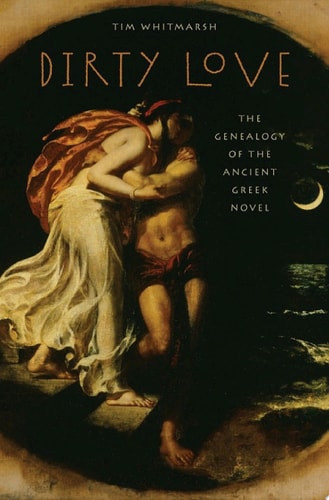
Dirty Love: The Genealogy of the Ancient Greek Novel
0
0
As an Amazon Associate and affiliate partner, Menrva Books earns from qualifying purchases. Learn more
Author Description
Some of the world's earliest large-form fictional narratives--what would today be called novels-are found in ancient Greece. Dating back to the first century CE, these narratives contain many of the elements common to the novelistic genre, for instance, the joining, separation, and reunion of two lovers. These ancient works have often been heralded as the ancestors of the modern novel; but what can we say of the origins of the Greek novel itself?This book argues that whereas much of Greek literature was committed to a form of cultural purism, presenting itself as part of a continuous tradition reaching back to the founding fathers within the tradition, the novel reveled in cultural hybridity. The earliest Greek novelistic literature combined Greek and non-Greek traditions. More than this, however, it also often self-consciously explored its own hybridity by focusing on stories of cultural hybridization, or what we would now call "mixed-race" relations. This book is thus not a conventional account of the origins of the Greek novel: it is not an attempt to pinpoint the moment of invention, and to trace its subsequent development in a straight line. Rather, it makes a virtue of the murkiness, or "dirtiness," of the origins of the novel: there is no single point of creation, no pure tradition, only transgression and transformation. The novel thus emerges as an outlier within the Greek literary corpus: a form of literature written in Greek, but not always committing to Greek cultural identity. Dirty Love focuses particularly on the relationship between Persian, Egyptian, Jewish and Greek literature, and explores such texts as Ctesias' Persica, Joseph and Aseneth, the Alexander Romance, and the tale of Ninus and Semiramis. It will appeal not only to those interested in Greek literary history, but also to readers of near eastern and biblical literature.
Menrva's Summary
THE THESIS
This book investigates the origins of the ancient Greek novel by challenging the notion of cultural purism in favor of a model defined by hybridity and cross-cultural exchange. Tim Whitmarsh, a scholar of Greek literature, utilizes a comparative framework to analyze how early narrative forms integrated Persian, Egyptian, and Jewish influences. He argues that the Greek novel functioned as a transgressive outlier that embraced cultural mixing rather than adhering to a singular, idealized Hellenic tradition.
THE SCOPE MAP
What You Will Find
- Analysis of texts including Ctesias' Persica, Joseph and Aseneth, the Alexander Romance, and the tale of Ninus and Semiramis.
- A theoretical framework focusing on cultural hybridization and the concept of 'dirtiness' in literary origins.
- Comparative study of Greek, Persian, Egyptian, and Jewish literary traditions.
Scope Limits
- The book does not attempt to provide a linear, chronological history of the novel's development.
- It does not seek to identify a single, definitive moment of invention for the genre.
THE AUTHORITY PERSPECTIVE
Scholars and students of classical literature frequently cite this work for its departure from traditional, Eurocentric narratives regarding the evolution of the novel. Readers often note the academic density of the prose, which provides a rigorous examination of how ancient texts navigated complex cultural identities.
Page Count:
224
Publication Date:
2018-01-01
Publisher:
Oxford University Press
ISBN-10:
0190880783
ISBN-13:
9780190880781
Comparative
Criticism history
Ancient History
English
English & College Success
Literary Criticism
Community Tags
Similar Books