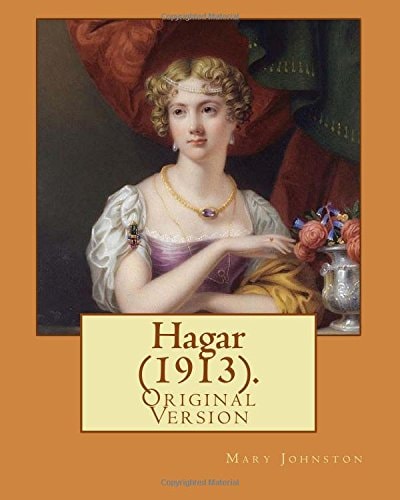
Hagar
0
0
As an Amazon Associate and affiliate partner, Menrva Books earns from qualifying purchases. Learn more
Author Description
The first female novelist to top twentieth-century best-seller lists, Mary Johnston was also one of the most prominent and interesting southern suffragists. Hagar, an extraordinary prescient novel published in 1913, brings together her fictional flair and her serious committed feminism. An introduction by Marjorie Spruill Wheeler locates the novel in its historical context and enhances its value to the study of women in southern, and American, history and literature.................. Mary Johnston (November 21, 1870 - May 9, 1936) was an American novelist and women's rights advocate from Virginia. She was one of America's best selling authors during her writing career and had three silent films adapted from her novels. Early life: Mary Johnston was born in the small town of Buchanan, Virginia, the eldest child of John William Johnston, an American Civil War veteran, and Elizabeth Dixon Alexander Johnston. Due to frequent illness, she was educated at home by family and tutors. She grew up with a love of books and was financially independent enough to devote herself to writing. Career as novelist Johnston wrote historical books and novels that often combined romance with history. Her first book, Prisoners of Hope (1898), dealt with colonial times in Virginia as did her second novel, To Have and to Hold (1900), and later, Sir Mortimer (1904). The Goddess of Reason (1907) uses the theme of the French Revolution, and in Lewis Rand (1908) the author portrayed political life at the dawn of the 19th century. To Have and to Hold was serialized in The Atlantic Monthly in 1899 and published in book form 1900, by Houghton Mifflin. The book proved enormously popular and was the bestselling novel in the United States in 1900. Johnston's next work, titled Audrey, was the fifth bestselling book in the U.S. in 1902, and Sir Mortimer, serialized in Harper's Monthly magazine from November 1903 through April 1904, was published in 1904. Her best-selling 1911 novel on the American Civi
Menrva's Summary
THE PULSE
A young woman in the early 20th century grapples with societal expectations and her own burgeoning feminist ideals. Hagar, a novel by Mary Johnston, explores the life of its titular character as she navigates a world resistant to change and the growing women's suffrage movement. The narrative likely contrasts Hagar's personal aspirations with the constraints imposed by her era and social standing, drawing on Johnston's own experiences as a prominent suffragist. The novel's framework is expected to be a third-person narrative, focusing on Hagar's internal and external struggles.
INSIDE THE PAGES
- Exploration of early 20th-century feminist thought and the suffrage movement.
- Character development of Hagar as she confronts societal norms.
- Historical context of the American South and its impact on women's lives.
- Interplay between personal desires and public activism.
- Mary Johnston's fictional flair combined with her committed feminism.
- Introduction by Marjorie Spruill Wheeler providing historical context.
- Themes of women's rights and their place in American history and literature.
THE COLLECTIVE ECHO
Hagar is recognized as an extraordinary and prescient novel, particularly for its time, by Mary Johnston, a leading female novelist and suffragist. The book is valued for its synthesis of fictional narrative with serious, committed feminism, offering insights into the historical context of women in the American South and the broader women's suffrage movement. Its inclusion of an introduction by Marjorie Spruill Wheeler further enhances its academic and historical significance for students of women's history and literature. The novel stands as a testament to Johnston's dual roles as a popular author and an advocate for women's rights.
Page Count:
172
Publication Date:
2017-10-21
Publisher:
CreateSpace Independent Publishing Platform
ISBN-10:
1978476280
ISBN-13:
9781978476288
Fiction
Historical Fiction
Feminism
Social History
Community Tags
Similar Books