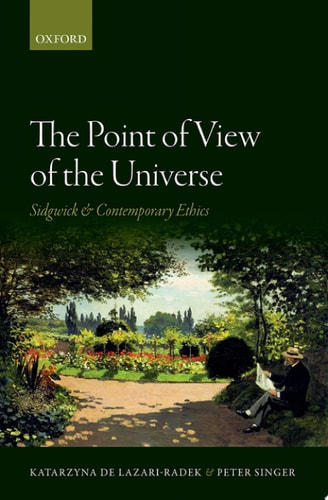
The Point of View of the Universe
0
0
As an Amazon Associate and affiliate partner, Menrva Books earns from qualifying purchases. Learn more
Author Description
What Does The Idea Of Taking 'the Point Of View Of The Universe' Tell Us About Ethics? The Great Nineteenth-century Utilitarian Henry Sidgwick Used This Metaphor To Present What He Took To Be A Self-evident Moral Truth: The Good Of One Individual Is Of No More Importance Than The Good Of Any Other. Ethical Judgments, He Held, Are Objective Truths That We Can Know By Reason. The Ethical Axioms He Took To Be Self-evident Provide A Foundation For Utilitarianism. He Supplements This Foundation With An Argument That Nothing Except States Of Consciousness Have Ultimate Value, Which Led Him To Hold That Pleasure Is The Only Thing That Is Intrinsically Good. Are These Claims Defensible? Katarzyna De Lazari-radek And Peter Singer Test Them Against A Variety Of Views Held By Contemporary Writers In Ethics, And Conclude That They Are. This Book Is Therefore A Defence Of Objectivism In Ethics, And Of Hedonistic Utilitarianism. The Authors Also Explore, And In Most Cases Support, Sidgwick's Views On Many Other Key Questions In Ethics: How To Justify An Ethical Theory, The Significance Of An Evolutionary Explanation Of Our Moral Judgments, The Choice Between Preference-utilitarianism And Hedonistic Utilitarianism, The Conflict Between Self-interest And Universal Benevolence, Whether Something That It Would Be Wrong To Do Openly Can Be Right If Kept Secret, How Demanding Utilitarianism Is, Whether We Should Discount The Future, Or Favor Those Who Are Worse Off, The Moral Status Of Animals, And What Is An Optimum Population.
Menrva's Summary
THE THESIS
This book investigates whether the utilitarian ethical framework proposed by Henry Sidgwick, centered on the 'point of view of the universe,' remains a defensible and objective moral foundation in contemporary discourse. The authors, Katarzyna de Lazari-Radek and Peter Singer, utilize Sidgwick's nineteenth-century axioms as a starting point to evaluate the validity of hedonistic utilitarianism. By applying rigorous logical analysis and comparing these historical claims against modern ethical theories, they construct a robust defense of moral objectivism and the pursuit of universal well-being.
THE SCOPE MAP
What You Will Find
- A detailed examination of Henry Sidgwick's moral axioms and their role in utilitarianism.
- Comparative analysis between hedonistic utilitarianism and preference-utilitarianism.
- Discussions on the moral status of animals, population ethics, and the conflict between self-interest and universal benevolence.
- Evaluations of evolutionary explanations regarding the origins of human moral judgments.
Scope Limits
- The text does not provide a comprehensive history of all utilitarian thought, focusing primarily on the specific framework established by Sidgwick.
- The analysis does not address non-utilitarian ethical systems in exhaustive detail, prioritizing the defense of the authors' chosen objective framework.
THE AUTHORITY PERSPECTIVE
Scholars and students of moral philosophy frequently identify this work as a significant modern contribution to the defense of classical utilitarianism. Readers often note the academic density of the prose, which requires a foundational understanding of ethical theory to fully engage with the authors' arguments.
Page Count:
320
Publication Date:
2014-01-01
Publisher:
Oup Oxford
ISBN-10:
019102242X
ISBN-13:
9780191022425
Non-Fiction
Philosophy
Utilitarianism
Ethics
Moral Philosophy
Community Tags
Similar Books