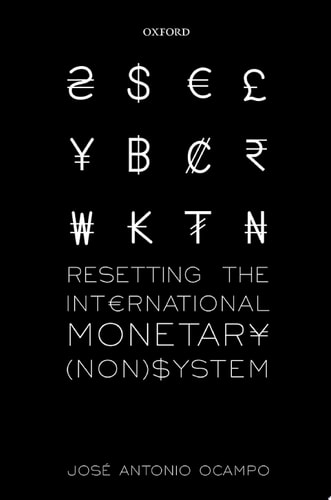
Resetting the International Monetary (Non)System
0
0
As an Amazon Associate and affiliate partner, Menrva Books earns from qualifying purchases. Learn more
Author Description
This is an open access title available under the terms of a CC BY-NC-SA 3.0 IGO licence. It is free to read at Oxford Scholarship Online and offered as a free PDF download from OUP and selected open access locations. International financial crises have plagued the world in recent decades, including the Latin American debt crisis of the 1980s, the East Asian crisis of the late twentieth century, and the global financial crisis of 2007-09. One of the basic problems faced during these crises is the lack of adequate preventive mechanisms, as well as insufficient instruments to finance countries in crisis and to overcome their over-indebtedness. Resetting the International Monetary (Non)System provides an analysis of the global monetary system and the necessary reforms that it should undergo to play an active role in the twenty-first century and proposes a comprehensive yet evolutionary reform of the system. Criticising the ad hoc framework- a "(non)system"- that has evolved following the breakdown of the Bretton Woods arrangement in the early 1970's, Resetting the International Monetary (Non)System places a special focus on the asymmetries that emerging and developing countries face, analysing the controversial management of crises by the International Monetary Fund and proposing a consistent set of reform proposals to design a better system of international monetary cooperation. Policy orientated and structured to deal in a sequential way with the issues involved, it suggests provision of international liquidity through a system that mixes the multicurrency arrangement with a more active use of the IMF's Special Drawing Rights; stronger mechanisms of macroeconomic policy cooperation, including greater cooperation in exchange rate management and freedom to manage capital flows; additional automatic balance-of-payments financing facilities and the complementary use of swap and regional arrangements; a multilateral sovereign debt workout mechanism; and major reforms of th
Menrva's Summary
THE THESIS
This work investigates the structural failures of the current international monetary framework and proposes a comprehensive reform agenda to address systemic instability. José Antonio Ocampo, a prominent economist and former Under-Secretary-General of the United Nations, utilizes historical data from major financial crises—including the 1980s Latin American debt crisis and the 2007-09 global financial crisis—to argue that the existing ad hoc arrangement is insufficient. He presents a framework for evolutionary reform that prioritizes the needs of emerging and developing economies while advocating for enhanced international cooperation.
THE SCOPE MAP
What You Will Find
- Analysis of the post-Bretton Woods international monetary (non)system.
- Proposals for the expanded use of IMF Special Drawing Rights.
- Frameworks for multilateral sovereign debt workout mechanisms.
- Strategies for managing capital flows and exchange rate volatility.
Scope Limits
- The text focuses primarily on systemic institutional reform rather than microeconomic corporate finance.
- It does not provide a detailed historical account of every individual national currency crisis.
THE AUTHORITY PERSPECTIVE
Experts recognize this text as a significant contribution to the discourse on global financial architecture and development economics. Readers frequently note the academic rigor and policy-oriented focus of the prose, making it a primary resource for students and practitioners of international political economy.
Page Count:
304
Publication Date:
2017-01-01
Publisher:
OUP Oxford
ISBN-10:
0191027952
ISBN-13:
9780191027956
Economics
Principles of Macroeconomics
Community Tags
Other Editions(2)
Similar Books

Reader Comments
Share Your Thoughts
No comments yet. Be the first to share your thoughts!