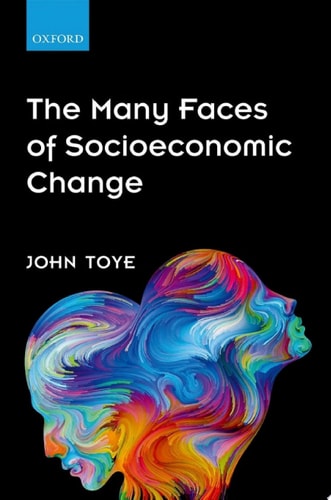
The Many Faces of Socioeconomic Change: Critical Frontiers of Theory, Research, and Policy in International Development Studies
0
0
As an Amazon Associate and affiliate partner, Menrva Books earns from qualifying purchases. Learn more
Author Description
Development is not a purely economic phenomenon; it also has a strong sociological element. The Many Faces of Socioeconomic Change explores how economic socio-cultural and political aspects of human progress have been studied since the time of Adam Smith. Surveying narratives of how development occurs, from early evolutionary models to recent types of development theory, it outlines the main long-term changes in how socioeconomic development has been envisaged through time. The Many Faces of Socioeconomic Change presents the argument that socioeconomic development emerged with the creation of grand evolutionary sequences of social progress that were the products of Enlightenment and mid-Victorian thinkers. By the middle of the twentieth century, when interest in accelerating development gave the topic a new impetus its scope narrowed to a set of economically based strategies. After 1960, however, faith in such strategies began to wane, in the face of indifferent results and a general faltering of confidence in economists' boasts of scientific expertise. In the twenty first century, development research is being pursued using research methods that generate disconnected results. As a result, it seems unlikely that any grand narrative will be created in the future and that Neo-liberalism will be the last of this particular kind of socioeconomic theory. With a broad scope of content and clear exposition of academic thinking this book guides the reader through the way in which the policy adopted as a consequence of modern theories has been less effective because of the neglect or a misunderstanding of the social context within which they operate.
Menrva's Summary
THE THESIS
This book investigates the historical evolution of socioeconomic development theory and argues that modern policy failures stem from a persistent neglect of the social context in which economic strategies operate. John F. J. Toye, an expert in development economics, utilizes a historical analysis of intellectual thought from the Enlightenment to the present day. He posits that the shift from grand evolutionary narratives to narrow, economically focused strategies has limited the efficacy of international development interventions. The text evaluates how the decline of confidence in scientific economic expertise has led to a fragmented landscape of contemporary research.
THE SCOPE MAP
What You Will Find
- Historical survey of development theories from Adam Smith to Neo-liberalism
- Analysis of the transition from grand evolutionary sequences to narrow economic models
- Critique of the disconnect between academic research methods and practical policy outcomes
- Examination of the sociological elements inherent in human progress
Scope Limits
- Does not provide a specific new model for future development policy
- Does not focus on localized case studies of specific developing nations
THE AUTHORITY PERSPECTIVE
Scholars and students of development studies frequently cite this work for its clear exposition of complex intellectual history. Experts highlight the text as a useful resource for understanding the limitations of modern economic policy through a sociological lens.
Page Count:
200
Publication Date:
2017-01-01
Publisher:
OUP Oxford
ISBN-10:
0191034940
ISBN-13:
9780191034947
Economics
Economic History
Family & Consumer Sciences
Sociology
Community Tags
Similar Books