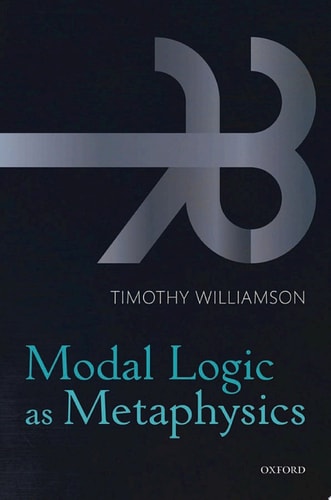
Modal Logic as Metaphysics
0
0
As an Amazon Associate and affiliate partner, Menrva Books earns from qualifying purchases. Learn more
Author Description
Are there such things as merely possible people, who would have lived if our ancestors had acted differently? Are there future people, who have not yet been conceived? Questions like those raise deep issues about both the nature of being and its logical relations with contingency and change. In Modal Logic as Metaphysics, Timothy Williamson argues for positive answers to those questions on the basis of an integrated approach to the issues, applying the technical resources of modal logic to provide structural cores for metaphysical theories. He rejects the search for a metaphysically neutral logic as futile. The book contains detailed historical discussion of how the metaphysical issues emerged in the twentieth century development of quantified modal logic, through the work of such figures as Rudolf Carnap, Ruth Barcan Marcus, Arthur Prior, and Saul Kripke. It proposes higher-order modal logic as a new setting in which to resolve such metaphysical questions scientifically, by the construction of systematic logical theories embodying rival answers and their comparison by normal scientific standards. Williamson provides both a rigorous introduction to the technical background needed to understand metaphysical questions in quantified modal logic and an extended argument for controversial, provocative answers to them. He gives original, precise treatments of topics including the relation between logic and metaphysics, the methodology of theory choice in philosophy, the nature of possible worlds and their role in semantics, plural quantification compared to quantification into predicate position, communication across metaphysical disagreement, and problems for truthmaker theory.
Menrva's Summary
THE THESIS
This book investigates whether modal logic can serve as a foundational framework for resolving metaphysical questions regarding existence, contingency, and change. Timothy Williamson, a prominent philosopher, utilizes the technical apparatus of quantified modal logic to argue that metaphysical theories are inseparable from logical commitments. He posits that higher-order modal logic provides a scientific setting for constructing and comparing rival metaphysical theories, rejecting the notion that logic can remain metaphysically neutral.
THE SCOPE MAP
What You Will Find
- Historical analysis of twentieth-century quantified modal logic development.
- Application of higher-order modal logic to metaphysical problems.
- Theoretical treatments of possible worlds, truthmaker theory, and plural quantification.
- Methodological framework for theory choice in philosophical discourse.
Scope Limits
- The text does not provide a general introduction to symbolic logic for absolute beginners.
- It does not attempt to reconcile modal logic with non-analytic or continental philosophical traditions.
THE AUTHORITY PERSPECTIVE
Experts recognize this work as a significant contribution to the intersection of formal logic and analytic metaphysics. Readers frequently note the high level of technical density, requiring a strong background in symbolic logic to fully engage with the author's arguments.
Page Count:
482
Publication Date:
2013-01-01
Publisher:
OUP Oxford
ISBN-10:
0191057401
ISBN-13:
9780191057403
Philosophy
Logic
Modal Logic
Logic & Critical Reasoning
Modality logic
Metaphysics
Community Tags
Similar Books