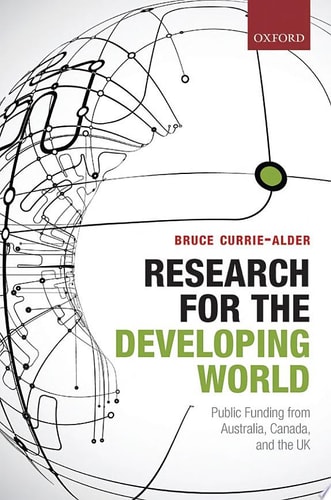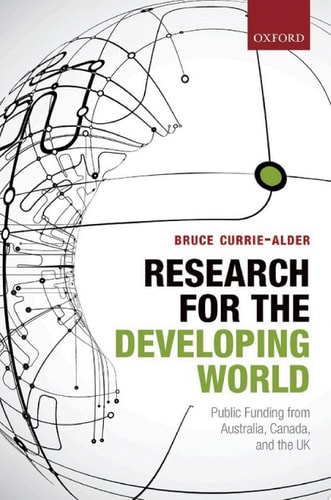
Research for the Developing World: Public Funding from Australia, Canada, and the UK
0
0
As an Amazon Associate and affiliate partner, Menrva Books earns from qualifying purchases. Learn more
Author Description
Research for the developing world can generate evidence on the effectiveness of foreign aid, invent new technologies that serve poor people, and strengthen research capabilities in poor countries. How do countries determine which of these policy goals to pursue? Examining the United Kingdom, Canada, and Australia reveals how each country established a unique approach to research funding. Programs and grantmaking evolved in response to various expectations across government, tempered by the need to remain credible in the scientific community. This book explores the histories of the UK Department for International Development (DFID), Canada's International Development Research Centre (IDRC), and the Australian Centre for International Agricultural Research (ACIAR). Looking back, changes in research governance encouraged a shift towards whole-of-government priorities, shorter timeframes for realizing results, and performance predicated on academic productivity and research impact. Whereas funders used to encourage 'small is beautiful' with local experiments in development, today the emphasis is on 'getting to scale' delivering innovation through self-financing models. Looking forward, research for the developing world is fading as part of development assistance, yet rising as collaboration on common global challenges. Funders are adopting new definitions of performance and actively shaping policy to connect science and international development. Leaders are brokering partnerships that connect research governance at home and abroad, bridging the incentives towards academic productivity and research impact. In short, the future of research for the developing world is moving from foreign aid to science diplomacy.
Menrva's Summary
THE THESIS
This book investigates how national governments determine the strategic goals and funding priorities for research initiatives aimed at the developing world. Bruce Currie-Alder, an expert in international development policy, utilizes a comparative historical analysis of funding agencies in the United Kingdom, Canada, and Australia. The work argues that research governance has shifted from localized, small-scale experimentation toward a model of science diplomacy focused on global challenges, measurable impact, and large-scale innovation.
THE SCOPE MAP
What You Will Find
- Comparative histories of DFID (UK), IDRC (Canada), and ACIAR (Australia)
- Analysis of the evolution of research governance and funding mandates
- Examination of the transition from foreign aid-based research to science diplomacy
- Discussion of performance metrics including academic productivity and research impact
Scope Limits
- The analysis is limited to the specific institutional frameworks of the UK, Canada, and Australia
- The text does not provide a comprehensive global survey of all international development research funders
THE AUTHORITY PERSPECTIVE
Experts identify this text as a rigorous examination of the intersection between public policy and scientific research funding. Readers frequently note the academic density of the prose, which provides a detailed institutional history for those interested in the mechanics of international development aid.
Page Count:
204
Publication Date:
2015-01-01
Publisher:
OUP Oxford
ISBN-10:
019106064X
ISBN-13:
9780191060649
Foreign Aid
Public Policy
International Development
Research Governance
Community Tags
Similar Books