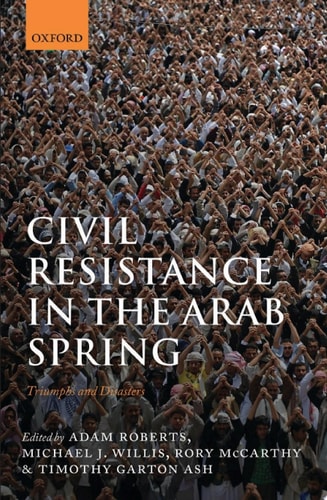
Civil Resistance in the Arab Spring: Triumphs and Disasters
0
0
As an Amazon Associate and affiliate partner, Menrva Books earns from qualifying purchases. Learn more
Author Description
Civil resistance, especially in the form of massive peaceful demonstrations, was at the heart of the Arab Spring-the chain of events in the Middle East and North Africa that erupted in December 2010. It won some notable victories: popular movements helped to bring about the fall of authoritarian governments in Tunisia, Egypt, Libya and Yemen. Yet these apparent triumphs of non-violent action were followed by disasters—wars in Syria, anarchy in Libya and Yemen, reversion to authoritarian rule in Egypt, and counter-revolution backed by external intervention in Bahrain. Looming over these events was the enduring divide between the Sunni and Shi'a branches of Islam. Why did so much go wrong? Was the problem the methods, leadership and aims of the popular movements, or the conditions of their societies? In this book, experts on these countries, and on the techniques of civil resistance, set the events in their historical, social and political contexts. They describe how governments and outside powers—including the US and EU—responded, how Arab monarchies in Jordan and Morocco undertook to introduce reforms to avert revolution, and why the Arab Spring failed to spark a Palestinian one. They indicate how and why Tunisia remained, precariously, the country that experienced the most political change for the lowest cost in bloodshed. This book provides a vivid illustrated account and rigorous scholarly analysis of the course and fate, the strengths and the weaknesses, of the Arab Spring. The authors draw clear and challenging conclusions from these tumultuous events. Above all, they show how civil resistance aiming at regime change is not enough: building the institutions and the trust necessary for reforms to be implemented and democracy to develop is a more difficult but equally crucial task.
Menrva's Summary
THE THESIS
This book investigates why the initial successes of civil resistance movements during the Arab Spring frequently devolved into political instability, civil war, or the restoration of authoritarian regimes. The authors, a team of experts in Middle Eastern politics and non-violent resistance, analyze the interplay between popular movements, state responses, and international intervention. By examining specific case studies across the region, they argue that while mass mobilization is effective at toppling governments, it is insufficient for the long-term construction of democratic institutions and social trust.
THE SCOPE MAP
What You Will Find
- Comparative analysis of uprisings in Tunisia, Egypt, Libya, Yemen, Syria, and Bahrain
- Examination of reformist strategies in monarchies like Jordan and Morocco
- Assessment of the role of external powers, including the US and EU
- Historical and social contextualization of the Sunni-Shi'a divide
Scope Limits
- Does not provide a comprehensive history of every political actor involved in the region
- Does not offer a predictive model for future revolutionary movements
THE AUTHORITY PERSPECTIVE
Experts recognize this work as a rigorous scholarly examination of the limitations of non-violent protest in the absence of institutional support. Readers frequently note the academic density of the prose and the authors' balanced approach to complex geopolitical outcomes.
Page Count:
355
Publication Date:
2016-01-01
Publisher:
OUP Oxford
ISBN-10:
0191088331
ISBN-13:
9780191088339
Sociology
Middle Eastern
International relations
Community Tags
Similar Books