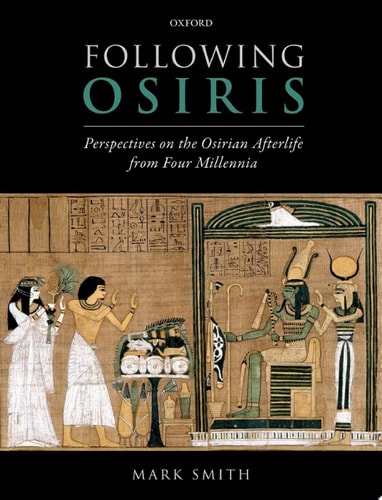
Following Osiris: Perspectives on the Osirian Afterlife from Four Millennia
0
0
As an Amazon Associate and affiliate partner, Menrva Books earns from qualifying purchases. Learn more
Author Description
Osiris, god of the dead, was one of ancient Egypt's most important deities. The earliest secure evidence for belief in him dates back to the fifth dynasty (c.2494-2345BC), but he continued to be worshipped until the fifth century AD. Following Osiris is concerned with ancient Egyptian conceptions of the relationship between Osiris and the deceased, or what might be called the Osirian afterlife, asking what the nature of this relationship was and what the prerequisites were for enjoying its benefits. It does not seek to provide a continuous or comprehensive account of Egyptian ideas on this subject, but rather focuses on five distinct periods in their development, spread over four millennia. The periods in question are ones in which significant changes in Egyptian ideas about Osiris and the dead are known to have occurred or where it has been argued that they did, as Egyptian aspirations for the Osirian afterlife took time to coalesce and reach their fullest form of expression. An important aim of the book is to investigate when and why such changes happened, treating religious belief as a dynamic rather than a static phenomenon and tracing the key stages in the development of these aspirations, from their origin to their demise, while illustrating how they are reflected in the textual and archaeological records. In doing so, it opens up broader issues for exploration and draws meaningful cross-cultural comparisons to ask, for instance, how different societies regard death and the dead, why people convert from one religion to another, and why they abandon belief in a god or gods altogether.
Menrva's Summary
THE THESIS
This book investigates the evolution of the Osirian afterlife by examining how the relationship between the deity Osiris and the deceased shifted across four millennia of Egyptian history. Mark Stephen Smith, a scholar of Egyptology, utilizes a combination of textual analysis and archaeological evidence to argue that religious belief is a dynamic, evolving phenomenon. By focusing on five critical periods of transformation, the author maps the development, maturation, and eventual decline of these funerary aspirations.
THE SCOPE MAP
What You Will Find
- Analysis of five distinct historical periods spanning from the fifth dynasty to the fifth century AD.
- Examination of the prerequisites required for the deceased to achieve an Osirian afterlife.
- Cross-cultural comparisons regarding societal attitudes toward death and religious conversion.
Scope Limits
- The text does not provide a continuous or comprehensive chronological history of all Egyptian funerary beliefs.
- It focuses specifically on the Osirian relationship rather than the entirety of the Egyptian pantheon or afterlife geography.
THE AUTHORITY PERSPECTIVE
Experts recognize this work as a focused study that successfully treats religious belief as a fluid historical process rather than a static set of dogmas. Readers often note that the text provides a clear, scholarly framework for understanding the shifting nature of ancient Egyptian funerary practices.
Page Count:
665
Publication Date:
2017-01-01
Publisher:
OUP Oxford
ISBN-10:
0191089761
ISBN-13:
9780191089763
History
Religion
Mythology
Ancient Egypt
Archaeology
Ancient History
Death Studies
Community Tags
Similar Books