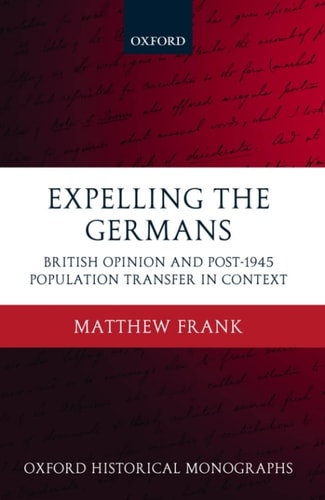
Expelling the Germans: British Opinion and Post-1945 Population Transfer in Context
0
0
As an Amazon Associate and affiliate partner, Menrva Books earns from qualifying purchases. Learn more
Author Description
Expelling the Germans focuses on how Britain perceived the mass movement of German populations from Poland and Czechoslovakia at the end of the Second World War. Drawing on a wide range of British archival material, Matthew Frank examines why the British came to regard the forcible removal of Germans as a necessity, and evaluates the public and official responses in Britain once mass expulsion became a reality in 1945. Central to this study is the concept of 'population transfer': the contemporary idea that awkward minority problems could be solved rationally and constructively by removing the population concerned in an orderly and gradual manner, while avoiding unnecessary human suffering and economic disruption. Dr Frank demonstrates that while most British observers accepted the principle of population transfer, most were also consistently uneasy with the results of putting that principle into practice. This clash of 'principle' with 'practice' reveals much not only about the limitations of Britain's role but also the hierarchy of British priorities in immediate post-war Europe.
Menrva's Summary
THE THESIS
This work investigates how British officials and the public reconciled the theoretical concept of orderly population transfer with the chaotic reality of the mass expulsion of Germans from Poland and Czechoslovakia after 1945. Matthew Frank, a historian specializing in twentieth-century European history, utilizes extensive British archival records to analyze the shift in British policy and moral perception during this period. The book argues that while the British government initially viewed population transfer as a rational solution to ethnic minority conflicts, the practical implementation of these policies created a persistent tension between strategic priorities and humanitarian concerns.
THE SCOPE MAP
What You Will Find
- Analysis of British diplomatic and public discourse regarding the Potsdam Agreement and population shifts.
- Examination of the intellectual history of 'population transfer' as a geopolitical tool.
- Primary source evidence from British government archives and contemporary media reports.
Scope Limits
- The study does not provide a comprehensive history of the expulsions from the perspective of the displaced German populations themselves.
- The analysis is restricted to the British viewpoint and does not extensively cover the internal decision-making processes of the Polish or Czechoslovakian governments.
THE AUTHORITY PERSPECTIVE
Historians and scholars of post-war European reconstruction frequently cite this monograph for its rigorous archival research and nuanced examination of British foreign policy. Experts highlight the text as a significant contribution to understanding the moral complexities and limitations of Allied decision-making in the immediate aftermath of the Second World War.
Page Count:
280
Publication Date:
2008-01-01
Publisher:
Oxford University Press
ISBN-10:
0191528471
ISBN-13:
9780191528477
History
British History
International relations
Post-War
European History
Community Tags
Similar Books