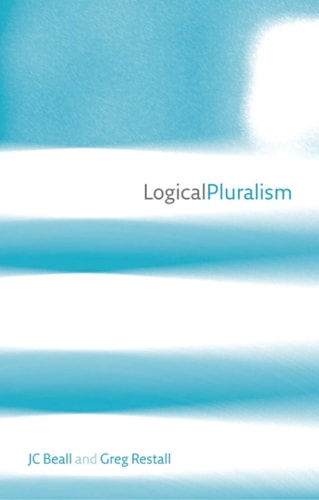
Logical Pluralism
0
0
As an Amazon Associate and affiliate partner, Menrva Books earns from qualifying purchases. Learn more
Author Description
Consequence is at the heart of logic; an account of consequence, of what follows from what, offers a vital tool in the evaluation of arguments. Since philosophy itself proceeds by way of argument and inference, a clear view of what logical consequence amounts to is of central importance to the whole discipline. In this book JC Beall and Greg Restall present and defend what thay call logical pluralism, arguing that the notion of logical consequence doesn't pin down one deductive consequence relation; it allows for many of them. In particular, they argue that broadly classical, intuitionistic, and relevant accounts of deductive logic are genuine logical consequence relations; we should not search for one true logic, since there are many. Their conclusions have profound implications for many linguists as well as for philosophers.
Menrva's Summary
THE THESIS
This book investigates the fundamental nature of logical consequence by arguing that there is no single, uniquely correct deductive logic. Authors J. C. Beall and Greg Restall, both established scholars in the field of philosophical logic, utilize formal semantic frameworks to challenge the monist assumption that only one logic governs all valid inferences. They propose a pluralist model where multiple distinct consequence relations—specifically classical, intuitionistic, and relevant logics—can all be considered valid depending on the context of the argument.
THE SCOPE MAP
What You Will Find
- Formal analysis of deductive consequence relations
- Comparative study of classical, intuitionistic, and relevant logic systems
- A defense of the pluralist thesis against monist objections
Scope Limits
- Does not provide an exhaustive survey of every non-classical logic system
- Does not address inductive or abductive reasoning frameworks
THE AUTHORITY PERSPECTIVE
Experts and philosophers frequently cite this work as a foundational text for understanding the debate between logical monism and pluralism. Readers often note the technical density of the prose, which requires a solid background in formal logic to fully appreciate the authors' arguments.
Page Count:
151
Publication Date:
2006-01-01
Publisher:
Clarendon Press
ISBN-10:
0191537144
ISBN-13:
9780191537141
Philosophy
Logic
Logic & Critical Reasoning
Metalogic
Epistemology
Causation
Academic
Community Tags
Similar Books