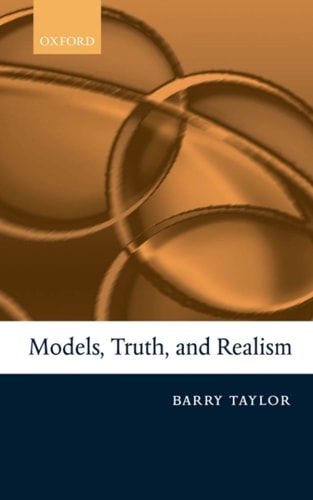
Models, Truth, and Realism
0
0
As an Amazon Associate and affiliate partner, Menrva Books earns from qualifying purchases. Learn more
Author Description
Barry Taylor's book mounts an argument against one of the fundamental tenets of much contemporary philosophy, the idea that we can make sense of reality as existing objectively, independently of our capacities to come to know it. Part One sets the scene by arguings that traditional realism can be explicated as a doctrine about truth - that truth is objective, that is, public, bivalent, and epistemically independent. Part Two, the centrepiece of the book, shows how a form of Hilary Putnam's model-theoretic argument demonstrates that no such notion of truth can be founded on the idea of correspondence, as explained in model-theoretic terms (more traditional accounts of correspondence having been already disposed of in Part One). Part Three argues that non-correspondence accounts of truth - truth as superassertibility or idealized rational acceptability, formal conceptions of truth, Tarskian truth - also fail to meet the criteria for objectivity; along the way, it also dismisses the claims of the latterday views of Putnam, and of similar views articulated by John McDowell, to constitute a new, less traditional form of realism. In the Coda, Taylor bolsters some of the considerations advanced in Part Three in evaluating formal conceptions of truth, by assessing and rejecting the claims of Robert Brandom to have combined such an account of truth with a satisfactory account of semantic structure. He concludes that there is no defensible notion of truth which preserves the theses of traditional realism, nor any extant position sufficiently true to the ideals of that doctrine to inherit its title. So the only question remaining is which form of antirealism to adopt.
Menrva's Summary
THE THESIS
This book investigates whether a coherent notion of objective truth can be sustained within the framework of traditional realism. Barry Taylor, a philosopher specializing in metaphysics and the philosophy of language, utilizes model-theoretic arguments to challenge the assumption that reality exists independently of human cognitive capacities. He systematically evaluates various theories of truth—including correspondence, superassertibility, and Tarskian formalisms—to demonstrate their failure in establishing an objective, epistemically independent reality.
THE SCOPE MAP
What You Will Find
- A critical analysis of traditional realism as a doctrine of objective, bivalent, and independent truth.
- An application of model-theoretic arguments, specifically addressing the work of Hilary Putnam.
- An evaluation of non-correspondence theories including superassertibility and idealized rational acceptability.
- A critique of semantic structures proposed by Robert Brandom and John McDowell.
Scope Limits
- The text does not provide a constructive defense of realism, focusing instead on the deconstruction of existing realist and antirealist positions.
- It does not offer a comprehensive history of philosophy, limiting its scope to specific contemporary debates regarding truth and semantic structure.
THE AUTHORITY PERSPECTIVE
Scholars in analytic philosophy recognize this work as a rigorous and technically demanding critique of contemporary metaphysical realism. Readers frequently note the high density of the prose, which requires a strong background in formal logic and model theory to navigate effectively.
Page Count:
208
Publication Date:
2006-01-01
Publisher:
Clarendon Press
ISBN-10:
0191536792
ISBN-13:
9780191536793
Philosophy
Logic
Epistemology
Metaphysics
Truth
Realism
Community Tags
Other Editions(4)



Similar Books


Reader Comments
Share Your Thoughts
No comments yet. Be the first to share your thoughts!