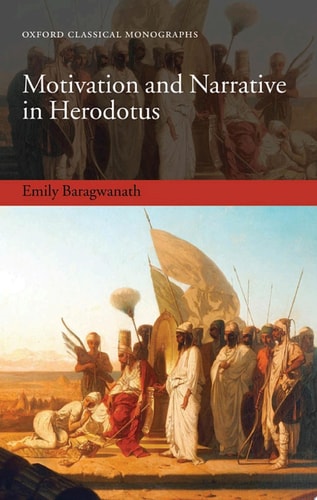
Motivation and Narrative in Herodotus
0
0
As an Amazon Associate and affiliate partner, Menrva Books earns from qualifying purchases. Learn more
Author Description
In His Extraordinary Story Of The Defence Of Greece Against The Persian Invasions Of 490-480 Bc, Herodotus Sought To Communicate Not Only What Happened, But Also The Background Of Thoughts And Perceptions That Shaped Those Events And Became Critical To Their Interpretation Afterwards. Much As The Contemporary Sophists Strove To Discover Truth About The Invisible, Herodotus Was Acutely Concerned To Uncover Hidden Human Motivations, Whose Depiction Was Vital To His Project Of Recounting And Explaining The Past. Emily Baragwanath Explores The Sophisticated Narrative Techniques With Which Herodotus Represented This Most Elusive Variety Of Historical Knowledge. Thus He Was Able To Tell A Lucid Story Of The Past While Nonetheless Exposing The Methodological And Epistemological Challenges It Presented. Baragwanath Illustrates And Analyses A Range Of These Techniques Over The Course Of A Wide Selection Of Herodotus' Most Intriguing Narratives - From Those On Athenian Democracy And Tyranny To Leonidas And Thermopylae - And Thus Supplies A Method For Reading The Histories More Generally.
Menrva's Summary
THE THESIS
This work investigates how Herodotus utilized specific narrative techniques to represent the internal motivations and perceptions of historical actors during the Persian Wars. Emily Baragwanath, a scholar of classical literature, examines the intersection of historical inquiry and literary artifice in The Histories. She argues that Herodotus did not merely record events but actively constructed a framework to explore the psychological and epistemological complexities of the past.
THE SCOPE MAP
What You Will Find
- Analysis of Herodotus' narrative strategies regarding human motivation
- Case studies on Athenian democracy, tyranny, and the Battle of Thermopylae
- Examination of the influence of contemporary Sophistic thought on historical writing
Scope Limits
- The text does not provide a comprehensive military history of the Persian Wars
- It does not offer a general biography of Herodotus
THE AUTHORITY PERSPECTIVE
Scholars recognize this work as a significant contribution to the study of Herodotus' methodology and narrative sophistication. Readers frequently note the academic density of the prose, which is intended for those with a background in classical historiography.
Page Count:
400
Publication Date:
2008-01-01
Publisher:
Ebsco Publishing
ISBN-10:
019155233X
ISBN-13:
9780191552335
History
Ancient Greece
Literary Criticism
Historiography
Herodotus
Community Tags
Other Editions(5)

Similar Books