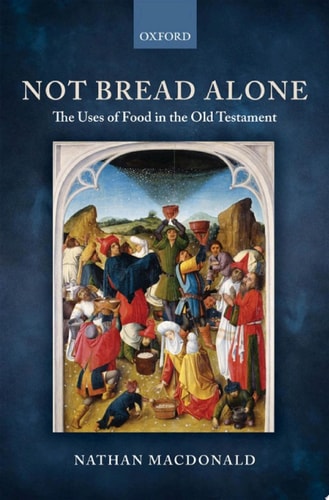
Not Bread Alone: The Uses of Food in the Old Testament
0
0
As an Amazon Associate and affiliate partner, Menrva Books earns from qualifying purchases. Learn more
Author Description
In ancient Israel the production of food was a basic concern of almost every Israelite. Consequently, there are few pages in the Old Testament that do not mention food, and food provides some of the most important social, political and religious symbols in the biblical text. Not Bread Alone is the first detailed and wide-ranging examination of food and its symbolism in the Old Testament and the world of ancient Israel. Many of these symbols are very well-known, such as the forbidden fruit in the Garden of Eden, the abominable pig and the land flowing with milk and honey. Nathan MacDonald demonstrates that the breadth biblical symbolism associated with food reaches beyond these celebrated examples, providing a collection of interrelated studies that draw on work on food in anthropology or other historical disciplines. The studies maintain sensitivity to the literary nature of the text as well as the many historical-critical questions that arise when studying it. Topics examined include: the nature and healthiness of the ancient Israelite diet; the relationship between food and memory in Deuteronomy; the confusion of food, sex and warfare in Judges; the place of feasting in the Israelite monarchy; the literary motif of divine judgement at the table; the use of food in articulating Israelite identity in the post-exilic period. The concluding chapter shows how some of these Old Testament concerns find resonance in the New Testament.
Menrva's Summary
THE THESIS
This work investigates the multifaceted role of food as a primary social, political, and religious symbol within the Old Testament and the broader context of ancient Israel. Prof. Nathan MacDonald, a scholar of the Hebrew Bible, utilizes a multidisciplinary framework that integrates historical-critical analysis with anthropological insights. He argues that food serves as a critical lens for understanding Israelite identity, divine judgment, and the cultural memory of the ancient Near East.
THE SCOPE MAP
What You Will Find
- Analysis of the ancient Israelite diet and its nutritional implications
- Examination of food symbolism in texts ranging from Genesis to the post-exilic period
- Exploration of the intersection between food, feasting, and political power in the monarchy
- Comparative study of food motifs in the New Testament
Scope Limits
- Does not provide a comprehensive culinary history of the entire ancient Near East
- Does not focus on archaeological excavation reports of food remains
THE AUTHORITY PERSPECTIVE
Scholars and students of biblical studies frequently cite this text for its innovative approach to integrating anthropological theory with traditional historical-critical methods. The prose is noted for its academic rigor while remaining accessible to those interested in the cultural and symbolic dimensions of the Hebrew Bible.
Page Count:
278
Publication Date:
2008-01-01
Publisher:
OUP Oxford
ISBN-10:
0191609390
ISBN-13:
9780191609398
Religion
Anthropology
Bibles
The Bible
Theology
Ancient History
Community Tags
Similar Books