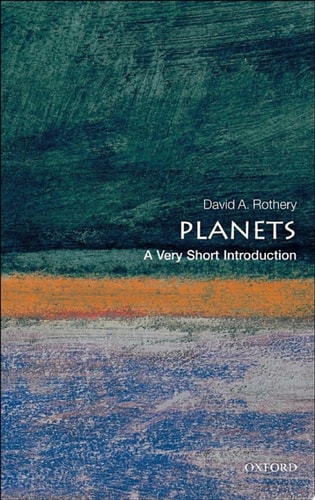
Planets: A Very Short Introduction
0
0
As an Amazon Associate and affiliate partner, Menrva Books earns from qualifying purchases. Learn more
Author Description
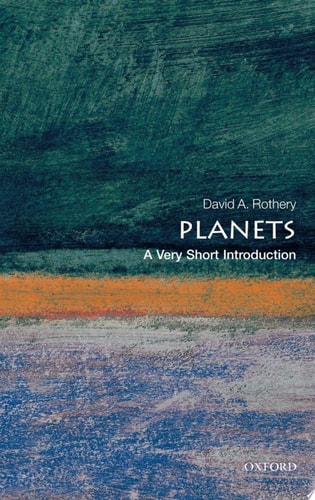
This Very Short Introduction looks deep into space and describes the worlds that make up our Solar System: terrestrial planets, giant planets, dwarf planets and various other objects such as satellites (moons), asteroids and Trans-Neptunian objects. It considers how our knowledge has advanced over the centuries, and how it has expanded at a growing rate in recent years. David A. Rothery gives an overview of the origin, nature, and evolution of our Solar System, including the controversial issues of what qualifies as a planet, and what conditions are required for a planetary body to be habitable by life. He looks at rocky planets and the Moon, giant planets and their satellites, and how the surfaces have been sculpted by geology, weather, and impacts. ABOUT THE SERIES: The Very Short Introductions series from Oxford University Press contains hundreds of titles in almost every subject area. These pocket-sized books are the perfect way to get ahead in a new subject quickly. Our expert authors combine facts, analysis, perspective, new ideas, and enthusiasm to make interesting and challenging topics highly readable.
Menrva's Summary
THE THESIS
This book investigates the physical characteristics, origins, and evolutionary processes of the various bodies within our Solar System. David A. Rothery, a professor of planetary geosciences, utilizes current astronomical data and historical scientific context to provide a comprehensive overview of planetary science. The text examines the definitions of planetary bodies and the environmental conditions necessary for habitability.
THE SCOPE MAP
What You Will Find
- Classification of terrestrial planets, giant planets, and dwarf planets
- Analysis of geological and atmospheric processes on planetary surfaces
- Discussion on the criteria for planetary status and life-sustaining conditions
Scope Limits
- Does not provide an exhaustive technical manual for deep-space navigation
- Excludes detailed mathematical derivations of orbital mechanics
THE AUTHORITY PERSPECTIVE
Experts and readers frequently cite this work as an accessible entry point for those seeking a concise, scientifically grounded overview of planetary science. The prose is noted for its clarity and ability to distill complex geological and astronomical concepts into a compact format.
Page Count:
153
Publication Date:
2010-01-01
Publisher:
OUP Oxford
ISBN-10:
0191614432
ISBN-13:
9780191614439
Science
Introductory Astronomy
Earth Sciences
Planetary Science
Astronomy
Physics