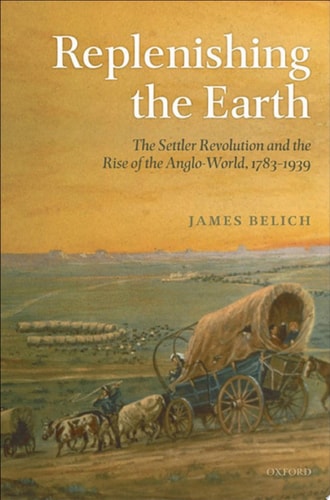
Replenishing the Earth: The Settler Revolution and the Rise of the Angloworld
0
0
As an Amazon Associate and affiliate partner, Menrva Books earns from qualifying purchases. Learn more
Author Description
Why are we speaking English? Replenishing the Earth gives a new answer to that question, uncovering a 'settler revolution' that took place from the early nineteenth century that led to the explosive settlement of the American West and its forgotten twin, the British West, comprising the settler dominions of Canada, Australia, New Zealand, and South Africa. Between 1780 and 1930 the number of English-speakers rocketed from 12 million in 1780 to 200 million, and their wealth and power grew to match. Their secret was not racial, or cultural, or institutional superiority but a resonant intersection of historical changes, including the sudden rise of mass transfer across oceans and mountains, a revolutionary upward shift in attitudes to emigration, the emergence of a settler 'boom mentality', and a late flowering of non-industrial technologies -wind, water, wood, and work animals - especially on settler frontiers. This revolution combined with the Industrial Revolution to transform settlement into something explosive - capable of creating great cities like Chicago and Melbourne and large socio-economies in a single generation. When the great settler booms busted, as they always did, a second pattern set in. Links between the Anglo-wests and their metropolises, London and New York, actually tightened as rising tides of staple products flowed one way and ideas the other. This 're-colonization' re-integrated Greater America and Greater Britain, bulking them out to become the superpowers of their day. The 'Settler Revolution' was not exclusive to the Anglophone countries - Argentina, Siberia, and Manchuria also experienced it. But it was the Anglophone settlers who managed to integrate frontier and metropolis most successfully, and it was this that gave them the impetus and the material power to provide the world's leading super-powers for the last 200 years. This book will reshape understandings of American, British, and British dominion histories in the long 19th century.
Menrva's Summary
THE THESIS
What historical mechanisms enabled the explosive expansion of the English-speaking world during the 19th and early 20th centuries? James Belich, a historian specializing in the history of settler societies, argues that this growth was driven by a 'settler revolution' characterized by mass migration, frontier boom-bust cycles, and the integration of peripheral settler economies with metropolitan centers like London and New York. He posits that this phenomenon, rather than inherent cultural or racial superiority, provided the material foundation for the rise of the Anglophone superpowers.
THE SCOPE MAP
What You Will Find
- Analysis of the 'settler revolution' across the American West, Canada, Australia, New Zealand, and South Africa.
- Examination of the 'boom mentality' and the role of non-industrial technologies in frontier development.
- Comparative study of settler societies including Argentina, Siberia, and Manchuria.
Scope Limits
- The analysis focuses primarily on the period between 1780 and 1930.
- The text does not provide an exhaustive political history of each individual dominion, focusing instead on the overarching economic and demographic patterns.
THE AUTHORITY PERSPECTIVE
Historians and scholars frequently cite this work as a significant contribution to the study of global settler colonialism and the economic integration of the nineteenth-century world. Readers often note the academic density of the prose, which synthesizes vast amounts of demographic and economic data to support its central argument.
Page Count:
586
Publication Date:
2011-01-01
Publisher:
OUP Oxford
ISBN-10:
019161971X
ISBN-13:
9780191619717
History
Migration Studies
Colonialism
Sociology
World history
Modern History
Economic History
Great Britain
Community Tags
Similar Books