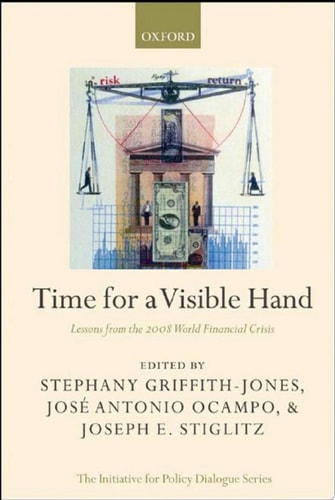
Time for a Visible Hand: Lessons from the 2008 World Financial Crisis
0
0
As an Amazon Associate and affiliate partner, Menrva Books earns from qualifying purchases. Learn more
Author Description
The financial crisis, which originated in developed country financial markets, quickly spread to developing countries. Governments and central banksthough taking many and costly measures were powerless to stop the global economic meltdown, as economies across the globe went into recession. The depth of the financial crisis means that the world economy is in unchartered territory. How do we restore robust growth and prevent another crisis? This book aims to systematically understand current major problems in the financial system, its governance, and in its links to global economic imbalances. It explains how both market actors and regulators behavior, and the prevailing ideology of extreme financial liberalization and deregulation, contributed to the financial crisis. This highly topical book focuses on the transparency and regulatory measures that are necessary to restore confidence in the financial system, to ensure that the financial system performs the roles that it should perform within both developing and developed countries, and to make a recurrence less likely. The book also describes reforms in the global financial architecture that might make the global financial system more stable and more equitable. The book presents sometimes radical, but specific, pragmatic, and politically feasible proposals to try to ensure a more stable, equitable, and growing world economy. Contributions come from both developed and developing countries and are written by leading authorities in their field, including senior nationalas well as internationalpolicy makers, practitioners from the private sector, and leading academics.
Menrva's Summary
THE THESIS
How can the global financial system be restructured to prevent future systemic collapses while fostering equitable, robust economic growth? The authors, led by Nobel laureate Joseph E. Stiglitz and a team of distinguished economists and policy experts, analyze the failures of extreme financial liberalization and deregulation that precipitated the 2008 crisis. They argue that the prevailing market-centric ideology ignored systemic risks, necessitating a more active, transparent, and regulated role for the state in both developed and developing economies.
THE SCOPE MAP
What You Will Find
- Analysis of the 2008 financial crisis origins and its transmission to developing nations
- Evaluation of global financial architecture and governance mechanisms
- Proposals for regulatory reform and transparency measures
- Perspectives from international policy makers and private sector practitioners
Scope Limits
- Does not provide a comprehensive history of all global economic recessions
- Focuses primarily on systemic financial regulation rather than micro-level corporate management
THE AUTHORITY PERSPECTIVE
Experts recognize this work as a significant contribution to the post-2008 policy discourse, particularly for its focus on the intersection of global governance and national economic stability. Readers frequently note the academic rigor of the prose, which balances complex economic theory with pragmatic, actionable policy recommendations.
Page Count:
396
Publication Date:
2010-01-01
Publisher:
OUP Oxford
ISBN-10:
0191610429
ISBN-13:
9780191610424
Economics
English & College Success
English
Linguistics
Principles of Microeconomics
Macroeconomics
Finance
Public Policy
Community Tags
Similar Books