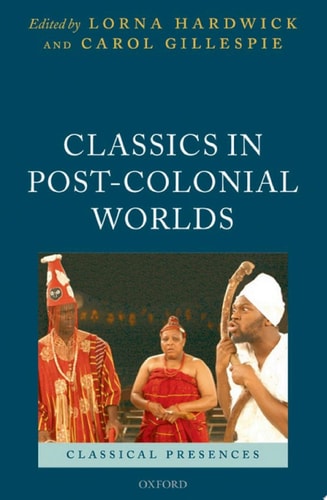
Classics in Post-Colonial Worlds
0
0
As an Amazon Associate and affiliate partner, Menrva Books earns from qualifying purchases. Learn more
Author Description
Classical material was traditionally used to express colonial authority, but it was also appropriated by imperial subjects to become first a means of challenging colonialism and then a rich field for creating cultural identities that blend the old and the new. Nobel prize-winners such as Derek Walcott and Seamus Heaney have rewritten classical material in their own cultural idioms while public sculpture in southern Africa draws on Greek and Roman motifs to represent histories of African resistance and liberation. These developments are explored in this collection of essays by international scholars, who debate the relationship between the culture of Greece and Rome and the changes that have followed the end of colonial empires.
Menrva's Summary
THE THESIS
This collection investigates how classical Greco-Roman material, once a tool of colonial authority, has been repurposed by post-colonial subjects to challenge imperial narratives and construct new cultural identities. Editors Carol Gillespie and Lorna Hardwick assemble a group of international scholars to analyze the intersection of classical antiquity and the post-colonial experience. The contributors examine how writers, artists, and political figures utilize classical motifs to articulate resistance, liberation, and the synthesis of disparate cultural histories in a world defined by the decline of empires.
THE SCOPE MAP
What You Will Find
- Analysis of classical appropriations in literature by authors such as Derek Walcott and Seamus Heaney.
- Examination of public sculpture and visual arts in southern Africa utilizing Greek and Roman motifs.
- Theoretical frameworks regarding the transition from colonial imposition to post-colonial cultural reclamation.
Scope Limits
- The text focuses primarily on the reception of classical antiquity rather than providing a comprehensive history of colonial governance.
- It does not cover every post-colonial region, focusing instead on specific case studies of cultural synthesis.
THE AUTHORITY PERSPECTIVE
Scholars and students of classical reception studies view this volume as a significant contribution to understanding how ancient texts remain active in contemporary political discourse. Readers frequently note the academic density of the prose, which serves as a foundational text for those exploring the intersection of classics and post-colonial theory.
Page Count:
439
Publication Date:
2010-01-01
Publisher:
OUP Oxford
ISBN-10:
0191615471
ISBN-13:
9780191615474
English
Academic
Cultural History
Literary Criticism
English literature
Modern Classical
English & College Success