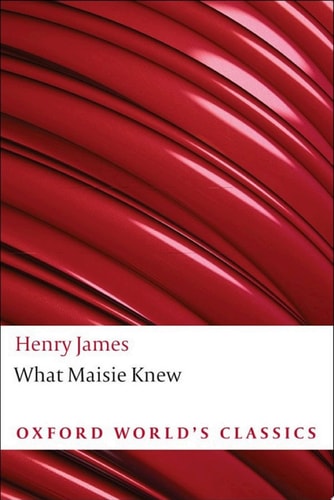
What Maisie Knew
0
0
As an Amazon Associate and affiliate partner, Menrva Books earns from qualifying purchases. Learn more
Author Description
What Maisie Knew (1897) represents one of James's finest reflections on the rites of passage from wonder to knowledge, and the question of their finality. The child of violently divorced parents, Maisie Farange opens her eyes on a distinctly modern world. Mothers and fathers keep changing their partners and names, while she herself becomes the pretext for all sorts of adult sexual intrigue. In this classic tale of the death of childhood, there is a savage comedy that owes much to Dickens. But for his portrayal of the child's capacity for intelligent `wonder', James summons all the subtlety he devotes elsewhere to his most celebrated adult protagonists. Neglected and exploited by everyone around her, Maisie inspires James to dwell with extraordinary acuteness on the things that may pass between adult and child. In addition to a new introduction, this edition of the novel offers particularly detailed notes, bibliography, and a list of variant readings. ABOUT THE SERIES: For over 100 years Oxford World's Classics has made available the widest range of literature from around the globe. Each affordable volume reflects Oxford's commitment to scholarship, providing the most accurate text plus a wealth of other valuable features, including expert introductions by leading authorities, helpful notes to clarify the text, up-to-date bibliographies for further study, and much more.
Menrva's Summary
THE PULSE
A young girl named Maisie Farange navigates the chaotic and morally ambiguous lives of her divorced parents, becoming a silent witness to their shifting alliances and adult indiscretions. Caught between the neglect of her biological parents and the manipulative intentions of their new partners, Maisie attempts to construct a coherent reality from the fragments of adult behavior she observes. The narrative framework utilizes a limited third-person perspective that focuses intensely on Maisie’s internal processing of external events, highlighting the disparity between her innocent observations and the complex, often predatory, adult world surrounding her. The story unfolds within the rigid social structures of late 19th-century England, where Maisie’s physical movements are dictated by the whims of the adults who treat her as a pawn in their personal conflicts.
INSIDE THE PAGES
- Limited third-person perspective centered on a child's consciousness
- Satirical critique of Victorian social and marital norms
- Exploration of the psychological impact of parental instability
- Intricate, nuanced prose style characteristic of late-period James
- Focus on the contrast between childhood perception and adult reality
- Themes of moral development and the loss of innocence
- Use of irony to expose the hypocrisy of the adult characters
- Detailed character studies of the secondary figures surrounding the protagonist
THE COLLECTIVE ECHO
Discussion often centers on the technical mastery James displays in maintaining a child's perspective while simultaneously conveying the complex, often sordid, realities of the adult world. Readers frequently highlight the tension between the savage comedy of the situation and the profound sadness inherent in Maisie’s exploitation. Critics often note the density of the prose, which demands careful attention to the subtle shifts in Maisie’s understanding of her environment. The novel is widely regarded as a significant study of how children interpret the moral failures of their guardians. Many readers find the ending particularly thought-provoking regarding the nature of independence and the finality of knowledge.
Page Count:
336
Publication Date:
2008-01-01
Publisher:
OUP Oxford
ISBN-10:
0191623105
ISBN-13:
9780191623103
Psychological
English & College Success
Classic Literature
Coming of Age
English
Victorian
Social Satire