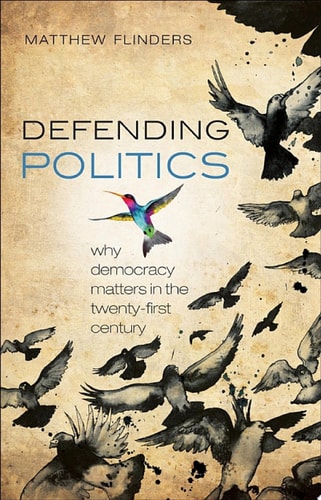
Defending Politics: Why Democracy Matters in the 21st Century
0
0
As an Amazon Associate and affiliate partner, Menrva Books earns from qualifying purchases. Learn more
Author Description
If the twentieth century witnessed the triumph of democracy then something appears to have gone seriously wrong. Citizens around the world have become distrustful of politicians, sceptical about democratic institutions, and disillusioned about the capacity of democratic politics to resolve pressing social concerns. This shift in global attitudes has been explored in a vast body of writing that examines the existence of 'disaffected democrats' and 'democratic deficits'. Defending Politics meets this contemporary pessimism about the political process head on. In doing so, it aims to cultivate a shift from the bland and fatalistic 'politics of pessimism' that appears to dominate public life towards a more buoyant and engaged 'politics of optimism'. Matthew Flinders makes a highly unfashionable but incredibly important argument of almost primitive simplicity: democratic politics delivers far more than most members of the public appear to acknowledge and understand. If more and more people are disappointed with what modern democratic politics delivers then is it possible that the fault lies with those who demand too much, fail to acknowledge the essence of democratic engagement and ignore the complexities of governing in the twentieth century rather than with democratic politics itself? Is it possible that the public in many advanced liberal democracies have become 'democratically decadent' in the sense that they take what democratic politics delivers for granted? Would politics be interpreted as failing a little less if we all spent a little less time emphasising our individual rights and a little more time reflecting on our responsibilities to society and future generations? Democratic politics remains 'a great and civilizing human activity... something to be valued almost as a pearl beyond price in the history of the human condition', as Bernard Crick stressed in his classic In Defence of Politics fifty years ago. But it is also a far more fragile system of governing
Menrva's Summary
THE THESIS
This book investigates the growing global disillusionment with democratic institutions and argues that the perceived failure of politics stems from unrealistic public expectations rather than inherent flaws in the democratic system. Professor Matthew Flinders, a specialist in governance and public policy, utilizes historical context and contemporary political analysis to challenge the prevailing 'politics of pessimism.' He posits that citizens in advanced liberal democracies have become 'democratically decadent,' taking the benefits of the system for granted while neglecting their own civic responsibilities.
THE SCOPE MAP
What You Will Find
- Analysis of the 'democratic deficit' and the rise of 'disaffected democrats.'
- A framework for transitioning from a culture of cynicism to a 'politics of optimism.'
- Examination of the balance between individual rights and collective societal responsibilities.
Scope Limits
- The text focuses primarily on advanced liberal democracies and does not provide a comprehensive global survey of non-democratic regimes.
THE AUTHORITY PERSPECTIVE
Scholars and political commentators frequently cite this work as a necessary counter-narrative to the widespread cynicism surrounding modern governance. Readers often note the accessible yet rigorous nature of the prose, which serves as a modern update to Bernard Crick's foundational theories on the value of political engagement.
Page Count:
221
Publication Date:
2012-01-01
Publisher:
OUP Oxford
ISBN-10:
0191623733
ISBN-13:
9780191623738
Sociology
Governance
Political Theory
Democracy
Community Tags
Similar Books