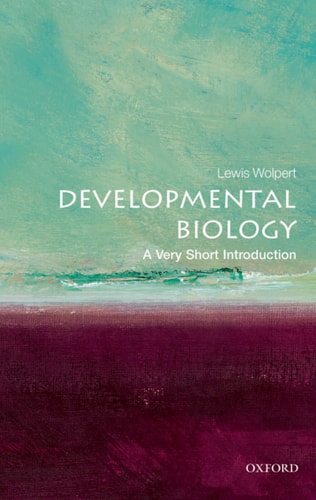
Developmental Biology: A Very Short Introduction
0
0
As an Amazon Associate and affiliate partner, Menrva Books earns from qualifying purchases. Learn more
Author Description
From a single cell - a fertilized egg - comes an elephant, a fly, or a human. How does this astonishing feat happen? How does the egg 'know' what to become? How does it divide into the different cells, the separate tissues, the brain, the fingernail - every tiniest detail of the growing foetus? These are the questions that the field of developmental biology seeks to answer. It is an area that is closely linked to genetics, evolution, and molecular biology. The processes are deeply rooted in evolutionary history; the information is held in genes whose vital timings in switching on and off is orchestrated by a host of proteins expressed by other genes. Timing is of the essence. Here, the distinguished developmental biologist Lewis Wolpert gives a concise account of what we now know about development, discussing the first vital steps of growth, the patterning created by Hox genes and the development of form, embryonic stem cells, the timing of gene expression and its management, chemical signalling, and growth. ABOUT THE SERIES: The Very Short Introductions series from Oxford University Press contains hundreds of titles in almost every subject area. These pocket-sized books are the perfect way to get ahead in a new subject quickly. Our expert authors combine facts, analysis, perspective, new ideas, and enthusiasm to make interesting and challenging topics highly readable.
Menrva's Summary
THE THESIS
This book investigates the fundamental biological mechanisms that allow a single fertilized egg to transform into a complex, multicellular organism. Lewis Wolpert, a distinguished developmental biologist, utilizes his extensive research background to synthesize complex genetic and molecular processes into an accessible framework. He argues that development is a highly orchestrated event governed by precise gene expression, chemical signaling, and evolutionary history.
THE SCOPE MAP
What You Will Find
- Mechanisms of embryonic development and cell differentiation
- The role of Hox genes in body patterning and form
- Principles of chemical signaling and gene expression timing
- Overview of embryonic stem cell function
Scope Limits
- Does not provide exhaustive clinical or medical applications
- Does not cover the entirety of advanced molecular biology techniques
THE AUTHORITY PERSPECTIVE
Experts and readers recognize this text as a highly efficient introduction to the field, praised for its ability to distill complex biological concepts into a concise format. The prose is noted for its academic clarity, making it a standard starting point for students and curious laypeople interested in the mechanics of life.
Page Count:
153
Publication Date:
2011-01-01
Publisher:
OUP Oxford
ISBN-10:
0191620572
ISBN-13:
9780191620577
Science
Biology
Developmental Biology
Genetics
Evolutionary Biology
Embryology