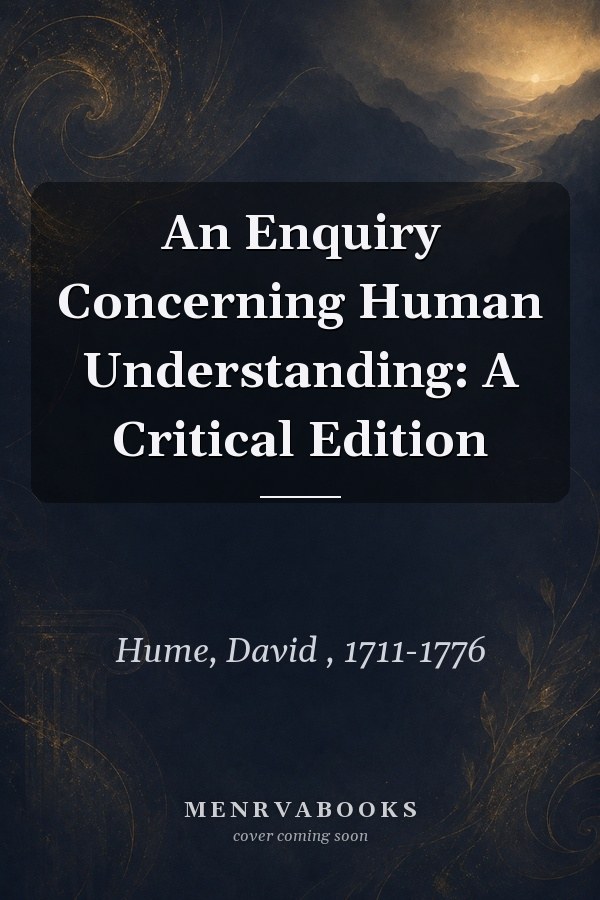
An Enquiry Concerning Human Understanding: A Critical Edition
0
0
As an Amazon Associate and affiliate partner, Menrva Books earns from qualifying purchases. Learn more
Author Description
Originally Written As A Collection Of Essays Centred On Human Understanding And The Principles Of Human Nature, The First Enquiry Is In Some Respects The Quintessential Enlightenment Book. It Incorporates A Confidence In Science, A Daring Attempt At New Discoveries About The Human Mind, An Opposition To Superstition And Fanaticism, An Emphasis On Human Nature, A Restrained Scepticism About Traditional Views Of Knowledge And Belief, And A Mood Of Reform And Critique. Hume Regarded The Bulk Of Ancient And Modern Philosophers As Having An Inflated, Even Pretentious, Faith In The Powers Of Human Reason. Many Of These Philosophers Thought That, Using Reason, They Could Establish The Existence And Nature Of God, Identify The Most Basic Entities That Comprise The Universe, And Grasp Eternal Truths Of Morality. Every Section Of The Enquiry Carries The Message That These Philosophers Are Overly Confident. Hume's Theses About The Limitations Of Human Understanding Form The Cement Of His Work In This Book And The Reason For Its Title. The Authoritative Version Of The Text Presented Here Is Based Upon The 1772 Edition That Was Seen Through The Press By Hume Himself. The Editor's Introduction Sets The Work In Its Historical Context, And A Large Body Of Annotations Provide Information About Hume's Sources, Allusions, Citations, And Meanings. A Biographical Appendix Identifies The Many People Mentioned By Hume. Separate And Extensive Bibliographies List The Works Cited By Hume And By The Editor. Hume's Original Index Is Reproduced, Together With A New General Index By The Editor. An Editorial Appendix Establishes The Substantive Variants In All The Editions Of The Work And Explains Editorial Emendations To The Text.--jacket. Of The Different Species Of Philosophy -- Of The Origin Of Ideas -- Of The Association Of Ideas -- Sceptical Doubts Concerning The Operations Of The Understanding -- Sceptical Solution Of These Doubts -- Of Probability -- Of The Idea Of Necessary Connexion --
Menrva's Summary
THE THESIS
This work investigates the fundamental limitations of human reason and the nature of knowledge, challenging the metaphysical certainty prevalent in 18th-century philosophy. David Hume, a central figure of the Scottish Enlightenment, utilizes an empirical framework to examine how human beings form beliefs and understand the world. By critiquing the over-reliance on abstract reasoning, he argues that human understanding is rooted in experience and custom rather than innate or divine truths.
THE SCOPE MAP
What You Will Find
- Analysis of the origin and association of ideas
- Examination of sceptical doubts regarding causality and probability
- A critical edition based on the 1772 text overseen by Hume
- Extensive editorial annotations, biographical appendices, and bibliographies
Scope Limits
- The text focuses primarily on the limits of human understanding rather than providing a comprehensive system of ethics or political theory.
- The analysis is confined to the specific arguments presented in the 1772 edition of the Enquiry.
THE AUTHORITY PERSPECTIVE
Scholars and philosophers recognize this text as a foundational document of modern empiricism and a primary source for understanding the transition to contemporary cognitive inquiry. Readers frequently note the academic density of the prose, which is balanced by the inclusion of comprehensive editorial apparatus that clarifies Hume's historical context and philosophical allusions.
Page Count:
0
Publication Date:
1900-01-01
Publisher:
Clarendon Press Oxford University Press
ISBN-10:
0191786381
ISBN-13:
9780191786389
Non-Fiction
Philosophy
Knowledge Theory
Epistemology
Enlightenment
Classical Philosophy
Hume David
Community Tags
Other Editions(2)
Similar Books


Reader Comments
Share Your Thoughts
No comments yet. Be the first to share your thoughts!