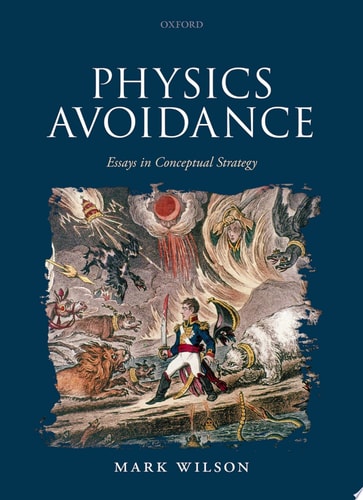
Physics Avoidance: And Other Essays in Conceptual Strategy
0
0
As an Amazon Associate and affiliate partner, Menrva Books earns from qualifying purchases. Learn more
Author Description
Mark Wilson presents a series of explorations of our strategies for understanding the world. 'Physics avoidance' refers to the fact that we frequently cannot reason about nature in the straightforward manner we anticipate, but must seek alternative policies that allow us to address the questions we want answered in a tractable way. Within both science and everyday life, we find ourselves relying upon thought processes that reach useful answers in opaque and roundabout manners. Conceptual innovators are often puzzled by the techniques they develop, when they stumble across reasoning patterns that are easy to implement but difficult to justify. But simple techniques frequently rest upon complex foundations--a young magician learns how to execute a card-guessing trick without understanding how its progressive steps squeeze in on a proper answer. As we collectively improve our inferential skills in this gradually evolving manner, we often wander into unfamiliar explanatory landscapes in which simple words encode physical information in complex and unanticipated ways. Like our juvenile conjurer, we fail to recognize the true strategic rationales underlying our achievements and may turn instead to preposterous rationalizations for our policies. We have learned how to reach better conclusions in a more fruitful way, but we remain baffled by our own successes. At its best, philosophical reflection illuminates the natural developmental processes that generate these confusions and explicates their complexities. But current thinking within philosophy of science and language works to opposite effect by relying upon simplistic conceptions of 'cause', 'law of nature', 'possibility', and 'reference' that ignore the strategic complexities in which these concepts become entangled within real-life usage. To avoid these distortions, better descriptive tools are wanted. The nine new essays within this volume illustrate this need for finer discriminations through a range of revealing ca
Menrva's Summary
THE THESIS
This collection investigates the discrepancy between the complex, often opaque strategies humans use to reason about the physical world and the simplistic philosophical frameworks typically employed to describe those processes. Mark Wilson, a professor of philosophy, utilizes his expertise in the philosophy of science and language to argue that our successful inferential techniques often rely on foundations we do not fully comprehend. He posits that we frequently adopt 'physics avoidance'—a method of bypassing direct physical reasoning in favor of tractable, roundabout strategies—and that current philosophical analysis fails to account for the strategic complexity inherent in these practices.
THE SCOPE MAP
What You Will Find
- Analysis of conceptual innovation in both scientific and everyday contexts
- Examination of the limitations of traditional philosophical concepts like 'cause' and 'law of nature'
- Nine original essays exploring the gap between practical reasoning and theoretical justification
Scope Limits
- The text does not provide a comprehensive history of scientific discovery
- It does not offer a manual for practical problem-solving in specific scientific disciplines
THE AUTHORITY PERSPECTIVE
Scholars in the philosophy of science recognize this work as a rigorous critique of standard analytical methodologies. Readers frequently note the academic density of the prose, which requires a strong background in philosophical terminology to fully grasp the author's arguments.
Page Count:
376
Publication Date:
2017-01-01
Publisher:
OUP Oxford
ISBN-10:
0192525247
ISBN-13:
9780192525246
Science
Philosophy
Logic
Science
Epistemology
Philosophy of
Community Tags
Similar Books