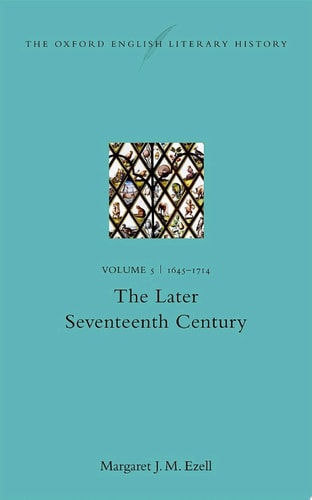
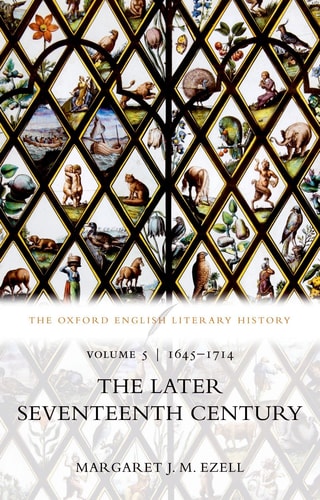
The Oxford English Literary History: Volume V: 1645-1714: The Later Seventeenth Century
0
0
As an Amazon Associate and affiliate partner, Menrva Books earns from qualifying purchases. Learn more
Author Description
The Oxford English Literary History is the new century's definitive account of a rich and diverse literary heritage that stretches back for a millennium and more. Each of these thirteen groundbreaking volumes offers a leading scholar's considered assessment of the authors, works, cultural traditions, events, and ideas that shaped the literary voices of their age. The series will enlighten and inspire not only everyone studying, teaching, and researching in English Literature, but all serious readers. This volume covers the period 1645-1714, and removes the traditional literary period labels and boundaries used in earlier studies to categorize the literary culture of late seventeenth-century England. It invites readers to explore the continuities and the literary innovations occurring during six turbulent decades, as English readers and writers lived through unprecedented events including a King tried and executed by Parliament and another exiled, the creation of the national entity 'Great Britain', and an expanding English awareness of the New World as well as encounters with the cultures of Asia and the subcontinent. The period saw the establishment of new concepts of authorship and it saw a dramatic increase of women working as professional, commercial writers. London theatres closed by law in 1642 reopened with new forms of entertainments from musical theatrical spectaculars to contemporary comedies of manners with celebrity actors and actresses. Emerging literary forms such as epistolary fictions and topical essays were circulated and promoted by new media including newspapers, periodical publications, and advertising and laws were changing governing censorship and taking the initial steps in the development of copyright. It was a period which produced some of the most profound and influential literary expressions of religious faith from John Milton's Paradise Lost and John Bunyan's Pilgrim's Progress, while simultaneously giving rise to a culture of libertinism
Menrva's Summary
THE THESIS
This volume investigates how the literary culture of late seventeenth-century England evolved amidst profound political, social, and religious upheaval between 1645 and 1714. Margaret J. M. Ezell, a distinguished scholar in the field, challenges traditional periodization by examining the continuities and innovations that defined this era. She argues that the period's literary output was inextricably linked to the emergence of new media, shifting concepts of authorship, and the expansion of England's global awareness.
THE SCOPE MAP
What You Will Find
- Analysis of the transition from the English Civil War through the formation of Great Britain.
- Examination of the rise of professional female writers and the commercialization of literature.
- Discussion of the impact of new media, including newspapers, periodicals, and early copyright laws.
- Exploration of major works by figures such as John Milton and John Bunyan alongside the culture of libertinism.
Scope Limits
- The text focuses specifically on the period between 1645 and 1714 and does not provide a comprehensive survey of the entire millennium of English literature.
- The analysis prioritizes cultural and social contexts over exhaustive biographical accounts of every minor author of the time.
THE AUTHORITY PERSPECTIVE
Scholars and students of English literature frequently cite this volume as a rigorous re-evaluation of a complex historical period. Readers note the academic density of the prose, which serves as a standard reference for understanding the intersection of political history and literary production.
Page Count:
598
Publication Date:
2017-01-01
Publisher:
OUP Oxford
ISBN-10:
0192537830
ISBN-13:
9780192537836
History
Non-Fiction
Literary History
English literature
Historical Events
Seventeenth Century
Academic
Community Tags
Other Editions(2)
Similar Books


Reader Comments
Share Your Thoughts
No comments yet. Be the first to share your thoughts!