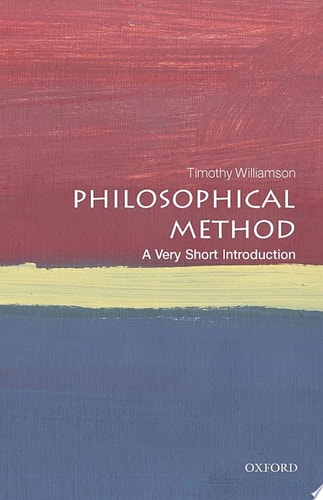
Philosophical Method: A Very Short Introduction
0
0
As an Amazon Associate and affiliate partner, Menrva Books earns from qualifying purchases. Learn more
Author Description
What are philosophers trying to achieve? How can they succeed? Does philosophy make progress? Is it in competition with science, or doing something completely different, or neither? Timothy Williamson tackles some of the key questions surrounding philosophy in new and provocative ways, showing how philosophy begins in common sense curiosity, and develops through our capacity to dispute rationally with each other. Discussing philosophy's ability to clarify our thoughts, he explains why such clarification depends on the development of philosophical theories, and how those theories can be tested by imaginative thought experiments, and compared against each other by standards similar to those used in the natural and social sciences. He also shows how logical rigour can be understood as a way of enhancing the explanatory power of philosophical theories. Drawing on the history of philosophy to provide a track record of philosophical thinking's successes and failures, Williams overturns widely held dogmas about the distinctive nature of philosophy in comparison to the sciences, demystifies its methods, and considers the future of the discipline. From thought experiments, to deduction, to theories, this Very Short Introduction will cause you to totally rethink what philosophy is. ABOUT THE SERIES: The Very Short Introductions series from Oxford University Press contains hundreds of titles in almost every subject area. These pocket-sized books are the perfect way to get ahead in a new subject quickly. Our expert authors combine facts, analysis, perspective, new ideas, and enthusiasm to make interesting and challenging topics highly readable. Previously published in hardback as Doing Philosophy
Menrva's Summary
THE THESIS
This book investigates the fundamental nature of philosophical inquiry, questioning whether philosophy constitutes a distinct discipline capable of progress or if it functions merely as an extension of scientific methodology. Timothy Williamson, a prominent philosopher and professor at the University of Oxford, utilizes his expertise in logic and epistemology to challenge traditional boundaries between philosophy and the natural sciences. He argues that philosophy evolves through rational dispute and the rigorous application of theoretical models, asserting that its methods are more aligned with scientific inquiry than is commonly acknowledged.
THE SCOPE MAP
What You Will Find
- Analysis of the role of thought experiments in philosophical theory testing
- Examination of the relationship between logical rigor and explanatory power
- Historical overview of philosophical successes and failures
- Comparison of philosophical standards to those used in social and natural sciences
Scope Limits
- Does not provide a comprehensive history of Western philosophy
- Does not serve as a general introduction to specific philosophical schools of thought
THE AUTHORITY PERSPECTIVE
Experts and academics frequently cite this work as a provocative contribution to meta-philosophy that successfully demystifies the discipline for a broader audience. Readers often note the high density of the prose, which requires careful attention despite the book's concise format.
Page Count:
160
Publication Date:
2020-01-01
Publisher:
OUP Oxford
ISBN-10:
019253811X
ISBN-13:
9780192538116
Philosophy
Non-Fiction
Logic
Epistemology
Academic