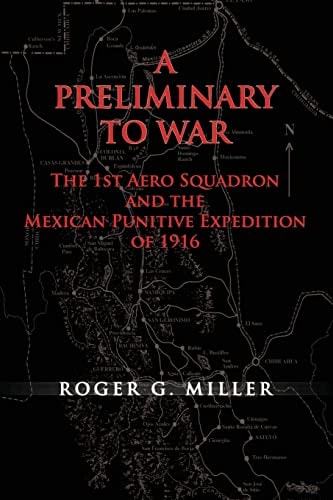
A Preliminary to War: The 1st Aero Squadron and the Mexican Punitive Expedition of 1916
0
0
As an Amazon Associate and affiliate partner, Menrva Books earns from qualifying purchases. Learn more
Author Description
On March 15, 1916, the 1st Aero Squadron arrived at Columbus, New Mexico, its train steaming into the crowded, chaotic town at 9:15 in the morning. Led by Capt. Benjamin D. Foulois, a lantern-jawed, bantam-weight former enlisted man, the squadron included eleven officers, eighty-two enlisted men, and one civilian technician. Under Foulois's direction, the men unloaded an automobile, six motorcycles, and twelve motor trucks, vehicles rare in 1916 New Mexico and even rarer in an army still wedded to the horse and mule. These were followed by wooden crates containing eight wood, wire, and fabric Curtiss JN-3 biplanes, every airplane owned by the U.S. Army, save those assigned to its aviation school at San Diego, California. The squadron was in Columbus to join an expedition commanded by Brig. Gen. John J. "Black Jack" Pershing. President Woodrow Wilson had ordered Pershing's force into Mexico in response to a March 9 attack on the tiny border town by the Mexican desperado, Francisco "Pancho" Villa. The event was auspicious. For the first time, the U.S. Army's entire air force-the 1st Aero Squadron-had deployed for an active campaign. The course of the Punitive Expedition can be quickly summarized. Pershing's forces crossed into Mexico on March 15, 1916, and for the next month, several carefully coordinated cavalry columns pressed southward hrough the state of Chihuahua in an effort to locate Villa, while trying to avoid confrontations with troops loyal to the Mexican government, who were unhelpful at best and often downright unfriendly. Behind the cavalry, the expedition was supported along a lengthening line of communications extending from Columbus through bases at Colonia Dublán, Namiquipa, Bachíniva, SanAntonio de los Arenales, and Satevó, the last over three hundred miles from the United States. The hard-riding cavalry ultimately reached Parral, another seven-ty miles south of Satevó, where a fight with Mexican government forces on April 15 marked the southern ter
Menrva's Summary
THE THESIS
The deployment of the entire U.S. Army Air Service marked a pivotal moment in military aviation history. The 1st Aero Squadron, comprising eleven officers, eighty-two enlisted men, and one civilian technician, arrived in Columbus, New Mexico, on March 15, 1916, equipped with the entirety of the U.S. Army's operational aircraft. Their mission was to support Brigadier General John J. Pershing's Punitive Expedition into Mexico, an operation launched in response to Pancho Villa's March 9th attack on the border town. This marked the first time the U.S. Army's air power was deployed for an active campaign, operating under challenging logistical conditions and in a politically sensitive environment.
THE SCOPE MAP
- Detailed account of the 1st Aero Squadron's arrival and composition.
- Description of the early 20th-century military vehicles and aircraft utilized.
- Contextualization of the U.S. Army's transition from horse-drawn to motorized transport.
- Chronological overview of General Pershing's Punitive Expedition into Mexico.
- Analysis of the logistical challenges and support network established during the campaign.
- Narrative of the cavalry's pursuit of Pancho Villa through Chihuahua.
- Account of confrontations with Mexican government forces.
THE AUTHORITY PERSPECTIVE
This work meticulously details the initial deployment of the U.S. Army's air arm in a significant historical campaign. The narrative focuses on the operational aspects, logistical challenges, and the historical context of the Mexican Punitive Expedition. The book appears to be a factual, research-driven account aimed at readers interested in early military aviation and American border history. Its detailed approach suggests it serves as a valuable resource for understanding this transitional period in warfare.
Page Count:
66
Publication Date:
2012-05-26
Publisher:
CreateSpace Independent Publishing Platform
ISBN-10:
1477546049
ISBN-13:
9781477546048
History
Non-Fiction
Military History
Mexican History
Aviation History
Community Tags
Similar Books







Reader Comments
Share Your Thoughts
No comments yet. Be the first to share your thoughts!