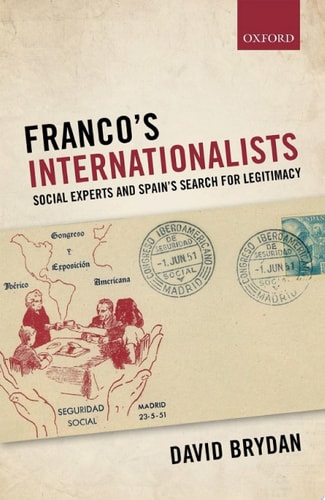
Franco's Internationalists: Social Experts and Spain's Search for Legitimacy
0
0
As an Amazon Associate and affiliate partner, Menrva Books earns from qualifying purchases. Learn more
Author Description
Despite the repression, violence, and social hardship which characterised Spanish life in the 1940s and 1950s, the Franco regime sought to win popular support by promoting its apparent commitment to social justice. David Brydan reveals the vital role which the idea of the Francoist 'social state' also played in the regime's ongoing search for international legitimacy. Using research from eighteen archives across six countries, Brydan shows how social experts, particularly those working in the fields of public health, medicine, and social insurance, were at the forefront of efforts to promote the regime abroad. By working with international organisations in Geneva, Paris, and New York and with transnational networks of colleagues across Europe, Africa, and Latin America, they sought to sell the idea of Franco's Spain as a respectable, modern, and socially-just state. They were internationalists, but they were Franco's internationalists. In telling this story, the study disrupts our understanding of the modern history of internationalism. Exploring what it meant for Francoist experts to think and act internationally, it challenges dominant accounts of internationalism as a liberal, progressive movement by foregrounding the history of fascist, nationalist, imperialist, and religious forms of international cooperation. It also brings into focus the overlooked continuities between international structures and projects before and after 1945. The case of Spain reveals the contested and heterogeneous nature of mid-twentieth century internationalism, characterised by the competition between overlapping global, regional, and imperial projects.
Menrva's Summary
THE THESIS
This book investigates how the Franco regime utilized social experts in medicine, public health, and social insurance to cultivate international legitimacy and project an image of a modern, socially-just state. David Brydan, a historian specializing in modern European history, draws upon extensive archival research from eighteen institutions across six countries to construct his argument. He posits that the regime's international engagement was not merely a peripheral activity but a core component of its survival strategy, challenging the traditional view of internationalism as an exclusively liberal or progressive endeavor. By examining the transnational networks of these experts, Brydan demonstrates how fascist and nationalist actors actively participated in global cooperation to normalize the Francoist state.
THE SCOPE MAP
What You Will Find
- Analysis of the Francoist 'social state' as a tool for diplomatic legitimacy.
- Examination of transnational networks in public health, medicine, and social insurance.
- Evidence from eighteen archives across six countries including Spain, Switzerland, France, and the United States.
- A critique of the post-1945 narrative regarding internationalism and its supposed liberal exclusivity.
Scope Limits
- The study focuses primarily on the 1940s and 1950s rather than the entire duration of the Franco regime.
- It does not provide an exhaustive biography of every social expert involved but focuses on those active in international organizations.
THE AUTHORITY PERSPECTIVE
Scholars in the field of modern European history recognize this work as a significant contribution to understanding the complexities of mid-twentieth-century internationalism. Readers frequently note the impressive depth of the archival research and the clarity with which the author challenges established historiographical boundaries.
Page Count:
214
Publication Date:
2019-01-01
Publisher:
OUP Oxford
ISBN-10:
0192571575
ISBN-13:
9780192571571
History
Twentieth Century
Social Conditions
European History
International relations
Spanish History
Community Tags
Similar Books