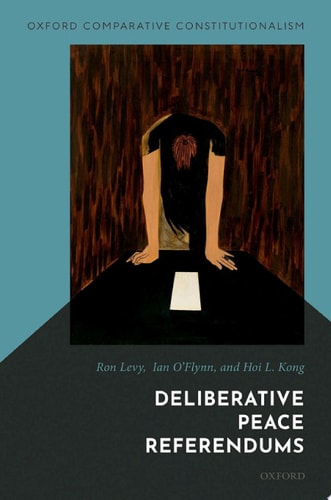
Deliberative Peace Referendums
0
0
As an Amazon Associate and affiliate partner, Menrva Books earns from qualifying purchases. Learn more
Author Description
'Peace referendums', which seek to manage conflict between warring groups, are increasingly common. Yet they remain erratic forces—liable as often to aggravate as to resolve tensions. This book argues that, despite their risks, referendums can play useful roles amid armed conflict. Drawing on a distinctive combination of the fields of deliberative democracy, constitutional theory and conflict studies, and relying on comparative examples (eg, from Algeria, Colombia, New Caledonia, Northern Ireland, Papua New Guinea, and South Africa), the book shows how peace referendums can fulfil their promise as genuine tools of conflict management.
Menrva's Summary
THE THESIS
This book investigates whether peace referendums can function as effective instruments for conflict resolution rather than catalysts for further instability. The authors, Ian O'Flynn, Hoi L. Kong, and Ron Levy, synthesize frameworks from deliberative democracy, constitutional theory, and conflict studies to evaluate the conditions under which these public votes succeed or fail. They argue that while referendums are inherently risky in volatile environments, specific procedural designs can mitigate tensions and foster genuine political reconciliation.
THE SCOPE MAP
What You Will Find
- Comparative analysis of peace referendums in Algeria, Colombia, New Caledonia, Northern Ireland, Papua New Guinea, and South Africa.
- A theoretical framework integrating deliberative democratic principles with constitutional design.
- Evaluation of the risks and potential benefits of direct democracy in post-conflict settings.
Scope Limits
- The analysis does not cover every historical instance of peace referendums, focusing instead on select case studies that illustrate specific constitutional challenges.
- The text does not provide a universal manual for conflict resolution, as it emphasizes the context-dependent nature of constitutional interventions.
THE AUTHORITY PERSPECTIVE
Experts in constitutional law and conflict studies identify this work as a significant contribution to the intersection of democratic theory and peacebuilding. Readers frequently note the academic density of the prose and the rigorous comparative methodology employed by the authors.
Page Count:
243
Publication Date:
2021-01-01
Publisher:
OUP Oxford
ISBN-10:
0192636871
ISBN-13:
9780192636874
International relations
Professional Career & Trade
Democracy
Conflict Studies
Peace studies
Constitutional Law